The 'future of payments' in Japan emphasizes the experience of seamlessly integrating into daily life, rather than focusing solely on new technologies like stablecoins. As payment methods diversify, adapting to the form that users find most convenient is key to widespread adoption.
With the spread of cashless payments, payments are transforming from mere transaction methods into 'data infrastructure for all activities.' Beyond PayPay's goal of 'defeating cash,' there is a vision of a world where payment barriers disappear, allowing individuals to live seamlessly.
Envisioning a future where banking and securities functions are integrated within an app starting with payments. As PayPay aims, the state where users find themselves completing asset management and remittances without conscious effort represents the 'future of payments' in a few years.
When discussing the 'future of payments' in Japan, it is crucial to first understand the current state of cashless payments, rather than focusing solely on the spread of new payment methods like cryptocurrencies and stablecoins.
In daily life, credit cards, electronic money, and QR code payments are already widely used as existing cashless methods. The extent of their adoption is a crucial indicator of whether stablecoin payments will be accepted by society. Currently, cashless adoption in Japan is steadily progressing.
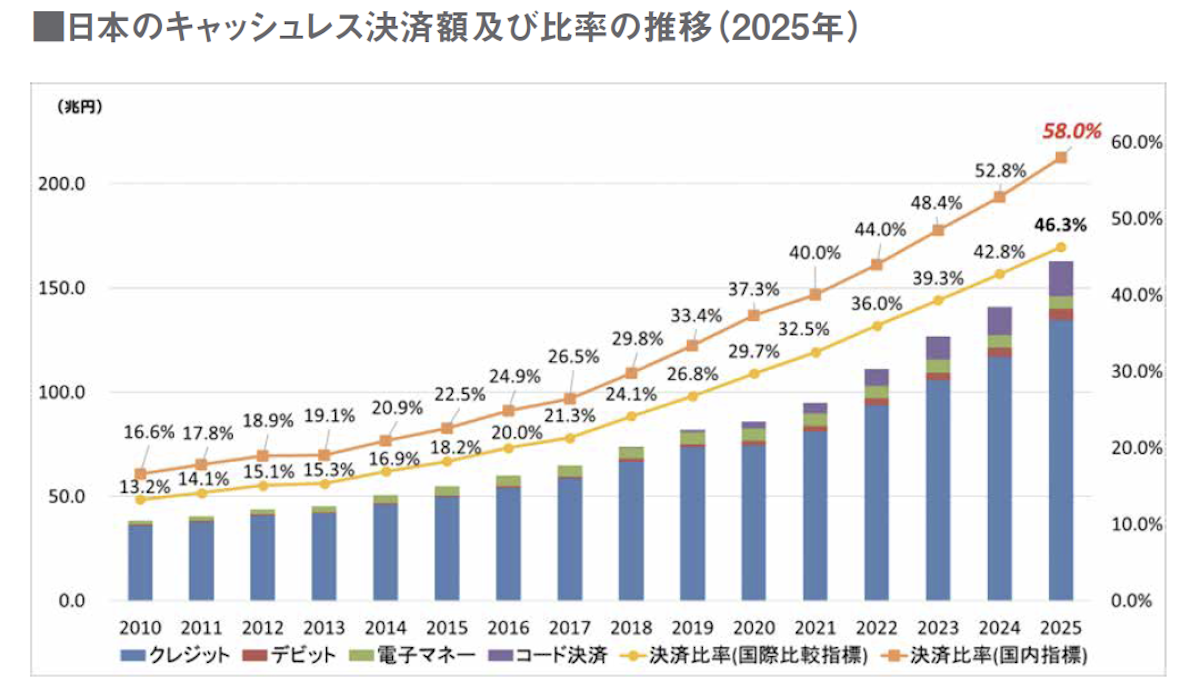
According to data released by the Ministry of Economy, Trade and Industry in March 2026, the cashless payment ratio is steadily rising to 58.0% by 2025.
This indicates the achievement of the government's target to increase the cashless payment ratio to around 40% by 2025. The government has set an interim goal to raise the ratio to 65% by 2030, but based on the 2025 data, early achievement is well within reach.
While the future target is a 'cashless payment ratio of 80%', no specific year for achievement has been indicated. However, if the current pace of cashless payment adoption continues, it is likely to be achieved as early as 2035, or by 2040 even if the pace slows.
Credit card payments account for about 80% of the total cashless payment value. They have been steadily increasing year by year, and it is a natural progression for credit card payment amounts to expand alongside the promotion of cashless payments. However, when looking at the overall ratio of cashless payments, credit card payments are showing a declining trend annually.
In contrast, QR code payments are rapidly expanding their share. In 2020, they held only a 3.7% share, but by 2025, they are projected to grow to 10.2%, showing approximately 2.75 times growth over five years. In terms of payment value, they have increased about 5.2 times over the same period, marking a significant expansion within cashless payments.