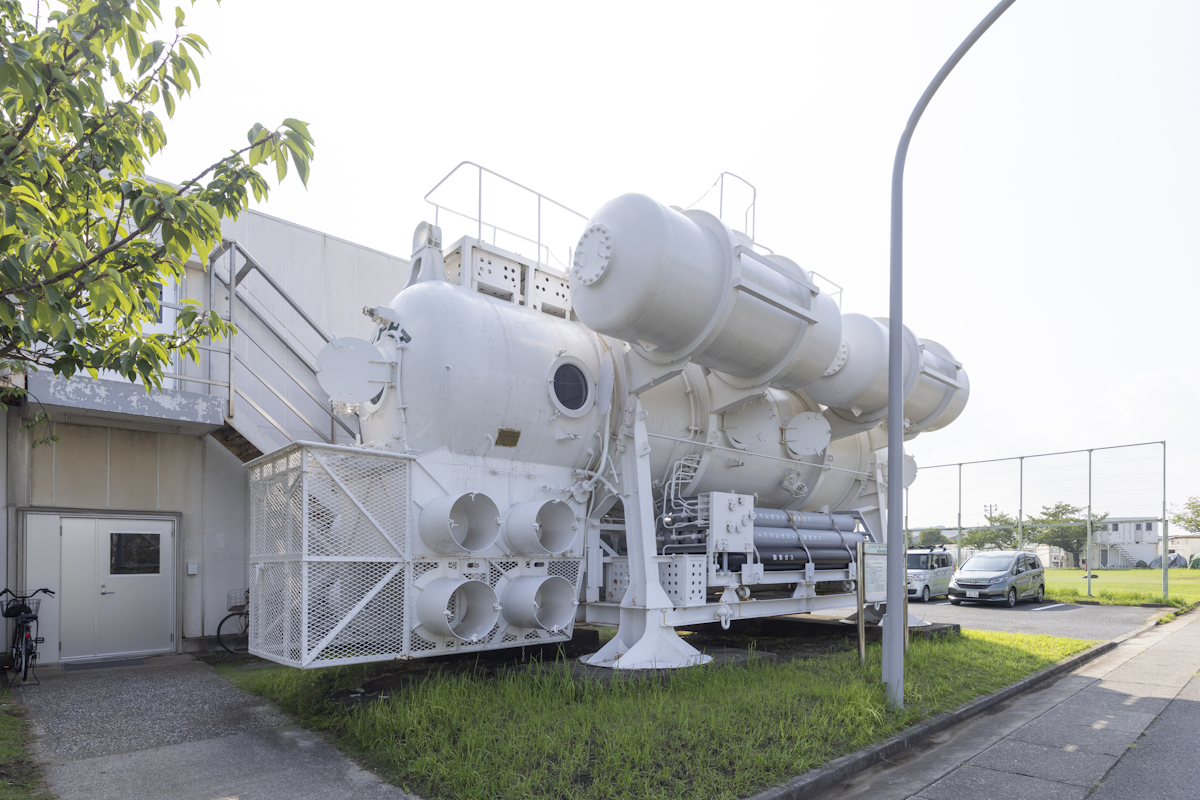
The Seatopia Project and Saturation Diving
Launched as a national project in the 1970s, the Seatopia Project aimed to develop underwater habitation facilities and saturation diving technology for operations at a depth of 300 meters. The project established techniques for saturating the body with a helium-oxygen gas mixture, achieving deep-sea access in 1988.
Challenges of Buoyancy and Exploration Robots
The realization of an undersea city was abandoned due to the challenge of mooring costs associated with the massive buoyancy of structures. However, this setback shifted the focus to manned and unmanned deep-sea exploration vehicles and work robots, significantly advancing Japan's deep-sea exploration technology.
Legacy and Prospects in Rescue Technology
The knowledge and data on saturation diving accumulated through the project are widely utilized today as life-saving technologies in maritime and water rescue operations. The dream of underwater habitation has transformed and continues as a challenge into the unknown with cutting-edge deep-sea exploration vehicles.
Many people may remember the undersea city depicted in a Doraemon movie from their childhood. A city built at the bottom of the sea where people live. While it seemed like mere fantasy as a child, Japan once seriously pursued a similar experiment. This was the 'Seatopia Project.'
This project, which combined the sea ('Sea') with the ideal world ('Utopia'), aimed to establish technology for humans to actually stay and work underwater in the 1970s. With renewed attention on seabed resources like rare earths in recent years, what has become of the undersea city concept?
We spoke with Hiroyoshi Nagane from JAMSTEC (Japan Agency for Marine-Earth Science and Technology), who was at the forefront of saturation diving and underwater habitation experiments at the time. The project's origins date back to before JAMSTEC's establishment, in 1968, when the Science and Technology Agency commissioned the Underwater Development Technology Association to research diving technology.
"It seems they continued diving experiments within the scope of what the association could do, but eventually, the goal of reaching a depth of 100 meters emerged. However, as the scale grew, it became difficult to manage with private funding. Thus, JAMSTEC was established in 1971, transitioning to a national project," Nagane explained.
It was an era driven by dreams of development, symbolized by the Apollo program. However, despite being a maritime nation, Japan lagged in marine development. While Western countries aimed for 300 meters with saturation diving technology, Japan lacked such technology. Moreover, the 1972 oil crisis sparked a call for domestic resource development. To cover the continental shelf near Japan, technology capable of reaching 300 meters was needed.
With national funding, experiments rapidly increased in depth. By 1972, they reached 30 meters, 60 meters the following year, and 100 meters by 1975, successfully establishing the technology to send humans to these depths. The method of sending humans to the deep sea is known as "saturation diving," where divers descend in a state where gases are dissolved in their body tissues, achieving "saturation."
When diving with regular air, nitrogen begins to dissolve excessively in the body around 30 meters, causing anesthetic effects (nitrogen narcosis). At 50 or 60 meters, even simple calculations become difficult. Therefore, they switched to a helium-oxygen gas mixture with less anesthetic effect and accumulated data on the optimal decompression speed to prevent "decompression sickness" during ascent.
Additionally, since 1971, they developed the "Habitat," a facility serving as a base for underwater operations. Divers used this base to spend two nights and three days at a depth of 60 meters.
"Underwater, fish gathered around the light leaking from the small windows of the Habitat," Nagane recalled.