1. Enhancing Risk Capital Circulation and Convenience
Mizuho FG has established a cross-group task force to advance its digital asset strategy. The aim is not merely to introduce blockchain, but to fundamentally enhance customer convenience and expand risk capital circulation.
2. Providing Payment Methods Tailored to Use Cases
Through the joint issuance of a stablecoin by the three megabanks, the goal is to build a new payment infrastructure. They anticipate optimal usage tailored to customer needs, such as tokenized deposits for large corporate transactions and stablecoins for the retail sector.
3. Strengthening the Core Functions of Banks and Integration with AI
As AI-driven automated payments advance, banks are required to adapt services to be chosen by AI agents and to establish new governance. Even with the proliferation of on-chain technology, the essential roles of banks, such as credit creation and financial intermediation, remain unchanged and are expected to be further strengthened.
── Could you tell us about the background of establishing the 'Digital Asset Task Force' within Mizuho Financial Group (hereafter, Mizuho FG) and your current initiatives?
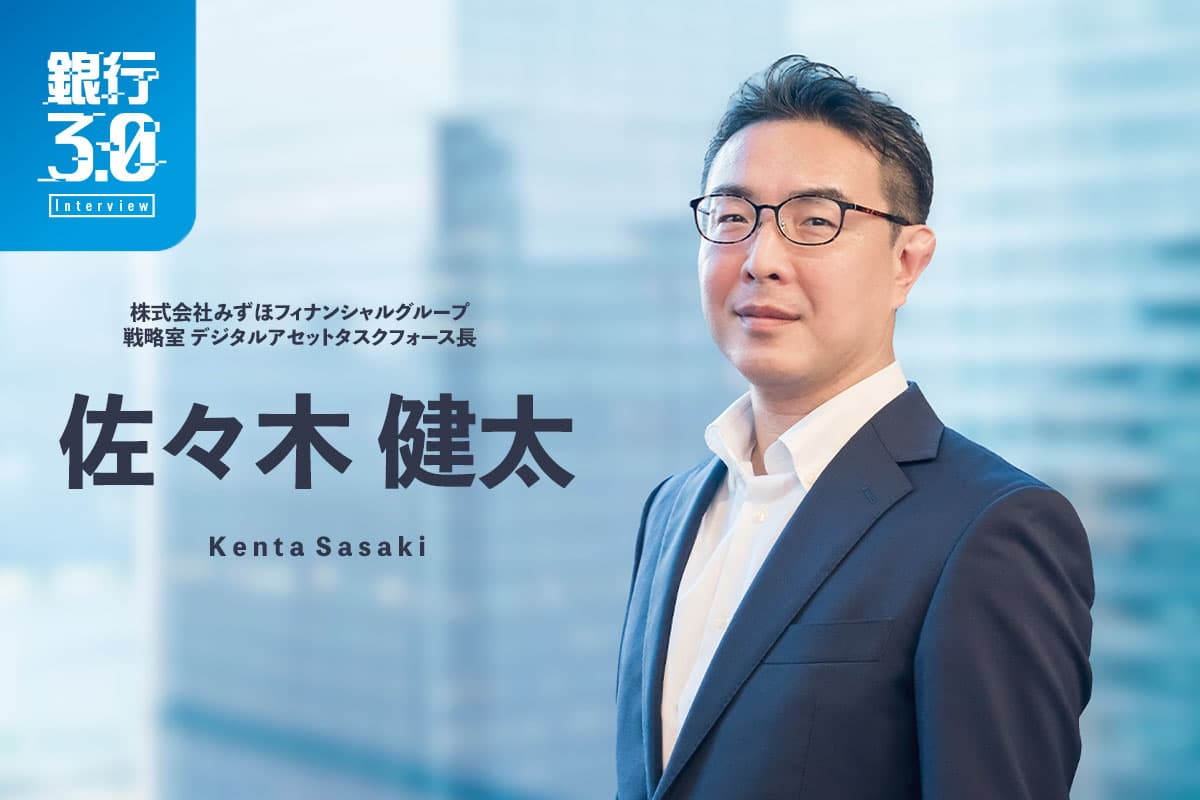
Kenta Sasaki (hereafter, Sasaki): The Digital Asset Task Force was established this fiscal year directly under Mizuho FG's CSO. It comprises members from various business lines across the group, aiming to comprehensively understand initiatives that have been individually pursued and to focus on key areas, enabling the group companies to collectively and intensively advance.
When launching this task force, we first defined our 'mission.' Our goal is to achieve 'expansion of risk capital circulation' and 'enhancement of convenience and practicality for society and customers' through digital asset initiatives.
The objective is not to use blockchain technology for its own sake. The essence lies in achieving enhanced customer convenience and expanded risk capital circulation as a result of utilizing blockchain. By establishing this axis, we can return to our core principles without hesitation in various decision-making situations that arise daily.
Currently, task force members are engaging in intensive discussions. Since understanding and perspectives on the business application of blockchain vary among departments and individuals within the group, the aim is to draw out the synergistic effects of each person's insights through discussions.
The task force repeatedly discusses and sets directions, directly proposing them to the business front lines. By frequently cycling through feedback from the front lines and refining proposals, we are steadily connecting business and technology.
── Discussions and implementations regarding the on-chain transformation of finance are accelerating domestically and internationally. How do you view the current status and progress of on-chain transformation in Japan?
Sasaki: I recognize that domestically, movements such as government inclusion of on-chain finance promotion in the 'Basic Policy' are accelerating verification and demonstration experiments.
This discussion cannot be confined to Japan alone. The boundary with the global market is inherently blurred, and it is in cross-border corporate and market transactions that blockchain's true value is tested. Considering the nature of on-chain transformation, it should be advanced on both domestic and international fronts.
Regarding the progress of on-chain transformation in finance overseas, I perceive that implementation is advancing in a slightly different form than initially expected. Previously, it was thought that both asset and cash sides would simultaneously transition to blockchain, but now flexible operations are beginning, utilizing blockchain on the asset side while using existing infrastructure for settlements.
The strengths of blockchain lie in its '24/7 operation,' 'compatibility with AI agents,' 'immediacy of transactions,' and 'programmability.' Since immediacy and programmability can be achieved to a certain extent with existing infrastructure, it is crucial to identify areas that can only be realized through blockchain.
Moreover, providing an ideal service five years later may not be as beneficial as offering an 80% complete service in one year for societal and customer convenience. I perceive that a realistic and speedy approach is required at this stage.