
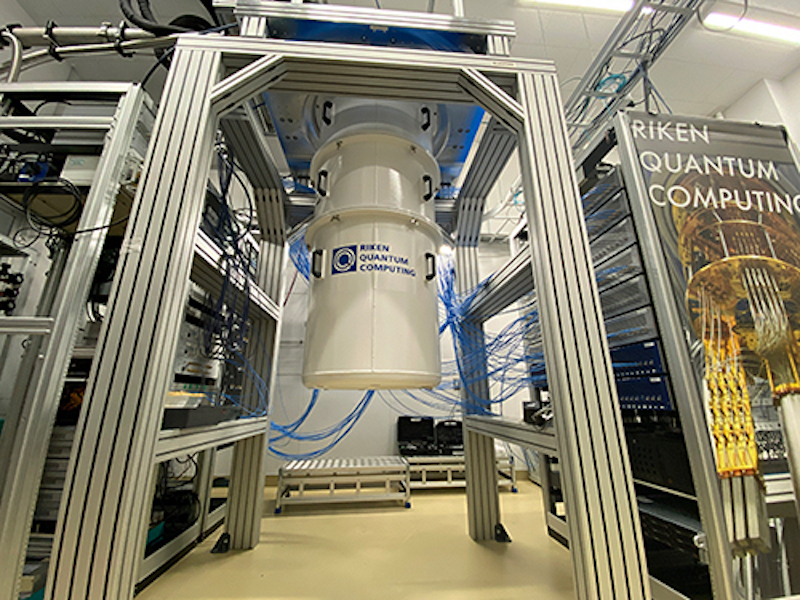
On the 5th, the RIKEN Institute of Physical and Chemical Research (RIKEN) announced that the nickname for the first domestically developed superconducting quantum computer has been decided to be "Ei (English spelling "A")".
The RIKEN Research Center for Quantum Computing (RQC) has been providing a quantum computer on the cloud since March 27th of this year, and is offering a "quantum computing cloud service" that can be used from outside.
RQC began accepting nickname submissions in April. The RIKEN group selected the nickname from 3,781 submissions.
"Ei" represents intelligence and represents the excellence and advanced nature of quantum computers in information processing, and the English name is the first letter of the alphabet, "A," which also expresses that this is the first step in the development of a domestically developed quantum computer.
▶ Quote from RIKEN
Ei has been developed by a collaborative research group led by RQC Director Yasunobu Nakamura. In addition to superconducting quantum bit integrated circuit technology, more than 100 researchers are involved in the development across various technology layers, such as package implementation, microwave control and readout wiring, microwave modulation and demodulation devices, digital control electronics, control software, quantum gate circuits, quantum error correction, quantum algorithms, and quantum applied computing.
The superconducting method used in Ei realizes quantum bits using tunnel junction elements with Josephson junctions on electronic circuits made of superconducting materials. It is one of the most promising methods for gate-type quantum computers in the future.
In 2001, RIKEN established the Macroscopic Quantum Coherence Research Team and began research on quantum information science. In 2021, the Quantum Computer Research Center was established under Dr. Nakamura to continue the research.
Also, on the same day, the 5th, the "RIKEN RQC-Fujitsu Collaboration Center," jointly established by Fujitsu Ltd. (Fujitsu) and RIKEN, announced that it would begin offering the "Fujitsu Hybrid Quantum Computing Platform," a hybrid quantum computing platform that can perform high-precision calculations by linking a new 64-qubit superconducting quantum computer based on Ei's development know-how with a 40-qubit quantum computer simulator, one of the largest in the world.
IBM and Google are ahead of the curve in quantum computers, but practical application still requires technological advances and huge investments. In expanding its quantum computer roadmap, IBM has announced plans to realize a 4,000-qubit system in 2025. Google also plans to develop a quantum computer equipped with 1 million qubits and capable of quantum error correction by 2029.
RIKEN has the advantage of being compatible with existing infrastructure, and is aiming for a sudden turnaround toward practical application.
Reference:Announcement
Image: Shutterstock


![[NEWS] RIKEN decides on nickname for first domestic quantum computer: "Ei"](/_next/image?url=https%3A%2F%2Fimages.microcms-assets.io%2Fassets%2F7819a9cf917e4bcd862bfa2ff5f14d24%2Fb4b03f5a2cb743af82c3096c8a512596%2Friken1k_2198551397.jpg&w=3840&q=75)