



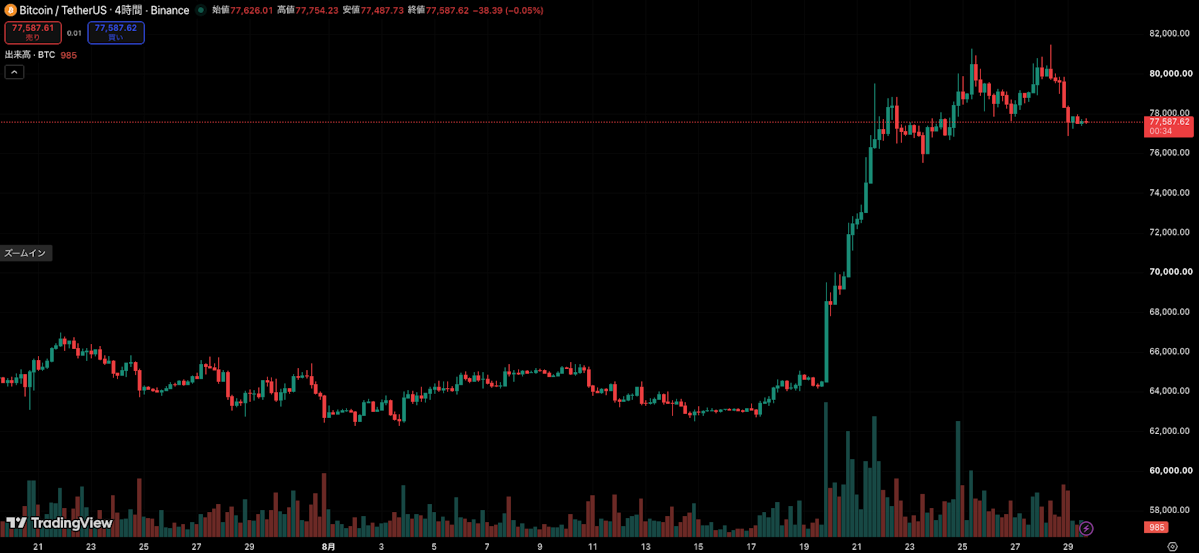
Bitcoin (BTC) gathered strong upward momentum late last week, briefly breaking through the key $80,000 mark. In the week through August 23, BTC surged 23%—its largest weekly gain in nearly three years, according to multiple media reports. Gains in yen terms were similarly sharp, underscoring robust capital inflows into the broader crypto market.
The primary catalyst for the rally was the U.S. Treasury’s August 19 announcement expanding its buyback operations for long-term Treasury bonds. By raising the per-operation cap from $2 billion to at least $4 billion, U.S. bond yields declined, enhancing the relative appeal of non-yielding Bitcoin. U.S. spot Bitcoin ETFs also recorded roughly $1.9 billion in weekly net inflows, reaching their highest level since October 2025. The fact that this was a sharp rebound from below $68,000 also served to amplify the percentage gain.
Additional catalysts were also at play. Speculation spread that capital seeking to evade sanctions might flow into crypto after U.S. Treasury Secretary Scott Bessent outlined plans to tighten sanctions against Iranian financial networks and digital assets.
However, after breaching $80,000, Bitcoin faced heavy resistance. In addition to profit-taking following the rapid surge, a heavy concentration of open interest at the $80,000 strike price ahead of the August 28 month-end options expiry acted as an upper bound on prices.
Furthermore, at the Jackson Hole Economic Symposium, Fed Chair Warsh identified inflation control as the top policy priority, raising concerns over potential interest rate hikes. Expectations of a rate hike as early as September sent U.S. yields higher, with the 10-year Treasury yield briefly touching 4.69% and causing BTC to temporarily dip below $77,000 over the weekend. Although Bitcoin logged its strongest weekly gain in three years, it remained a volatile market dictated by shifting U.S. monetary policy expectations.
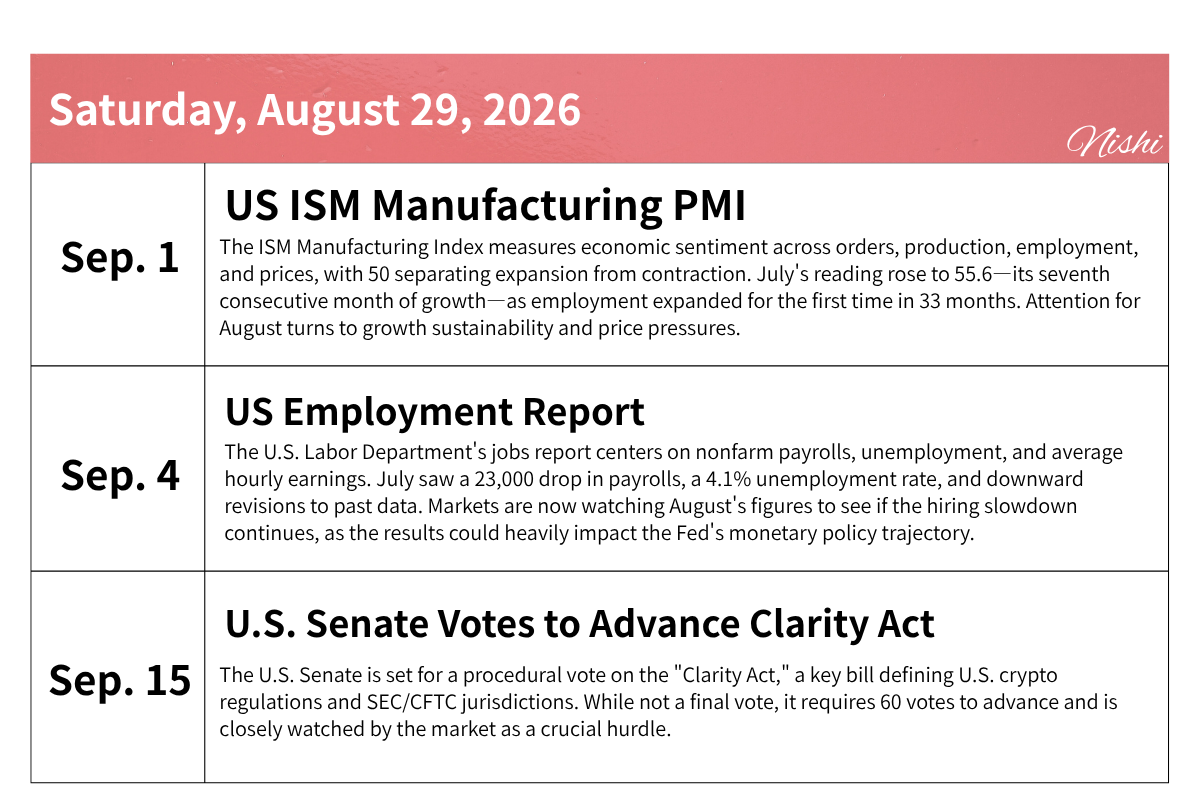
Since 2024, the rise of meme coins has further intensified this market structure. Lower technical barriers for token creation and distribution have made it effortless for celebrities and viral content creators to launch tokens tied directly to their names or personas.
Unlike traditional equities, meme coins fundamentally lack standard valuation metrics like corporate earnings or cash flows. Instead, their prices are driven purely by community enthusiasm, social media virality, and the expectation that someone else will buy in at a higher price. By their very nature, the economic interests of issuers, promoters, and early holders are deeply intertwined.
A prime example is the HAWK token, born from the viral "Hawk Tuah" internet meme. Although it surged immediately upon its December 2024 launch, its price subsequently plummeted by over 90%. Suspicions quickly mounted over early-insider holdings, high-frequency "sniper" trading, and a lack of transparency regarding token allocation. While this case does not instantly prove illegal conduct, it once again exposed the fundamental question haunting the crypto market: Who obtained the tokens at what price, and when were they able to sell?
In November 2024, a study published by crypto media outlet Coinwire analyzed 1,567 meme coins promoted by 377 influencers. It revealed that 86% lost 90% of their value within three months. While sampling methods and metrics warrant careful scrutiny, the data strongly suggests that an influencer’s fame rarely correlates with positive investment returns.
Further exposing this dynamic in September 2025, on-chain investigator ZachXBT released a dossier detailing outreach from a project to over 200 crypto influencers, complete with rate cards, wallet addresses, and payment logs. According to the investigator, out of more than 160 accounts that accepted the promotional deal, fewer than five explicitly disclosed the content as an ad. While the leaked documents require independent verification, the incident visibly exposed the extent to which crypto influencer marketing operates as a fully commercialized industry.
Regulators in Japan have also tightened rules surrounding deceptive promotions and personal endorsements. In October 2023, stealth marketing was designated an unfair trade practice under the Act against Unreasonable Premiums and Misleading Representations, making it illegal for businesses to obscure advertising intent. This applies even to social media posts by influencers if a brand is involved in determining the content. However, these enforcement actions primarily target the sponsoring business rather than directly punishing the influencer.
In the financial sector, Japan’s Financial Services Agency (FSA) has repeatedly warned against unregistered investment advice on social media and fraudulent schemes impersonating public figures. Yet, drawing a clear line between daily market commentary and regulated investment advice remains notoriously difficult. When promotions are framed as "personal impressions," "disclosing my own portfolio," or "community updates," verifying their true commercial nature or underlying financial ties becomes nearly impossible from the outside.
By 2026, amendments to Japan's Financial Instruments and Exchange Act have further expanded rules to enhance market integrity—tightening issuer disclosure requirements, clamping down on unregistered operators, and restricting unfair trading practices.
Even so, legislation alone cannot capture every promoted "top pick." When compensation is paid in tokens rather than fiat currency, or when complex networks of intermediaries stand between a project and a creator, distinguishing paid promotions from organic posts remains a formidable challenge.
ICOs, DeFi, NFTs, meme coins, and consumer tokens—while the market's dominant narratives change with every cycle, the core issue remains unchanged. The central question is whether a promoter acquired assets earlier, cheaper, and under more favorable exit terms than retail investors.
When unsuspecting followers buy a token based on an influencer's post, they inject fresh liquidity into the market. That very liquidity can then serve as the "exit strategy" for early holders to lock in their gains.
For investors, checking for a simple "#PR" or "#Ad" tag is not enough. Critical questions must be asked: Do the promoters or project insiders hold tokens? At what cost basis did they acquire them? Are there lock-up schedules or sale restrictions in place? Is a massive token unlock looming on the horizon?
Where on-chain data is available, metrics such as concentration among whale wallets, transfers from initial allocations to central exchanges, and market liquidity offer essential clues. In the crypto market, who is saying what matters far less than what position they hold—and when they are allowed to sell.
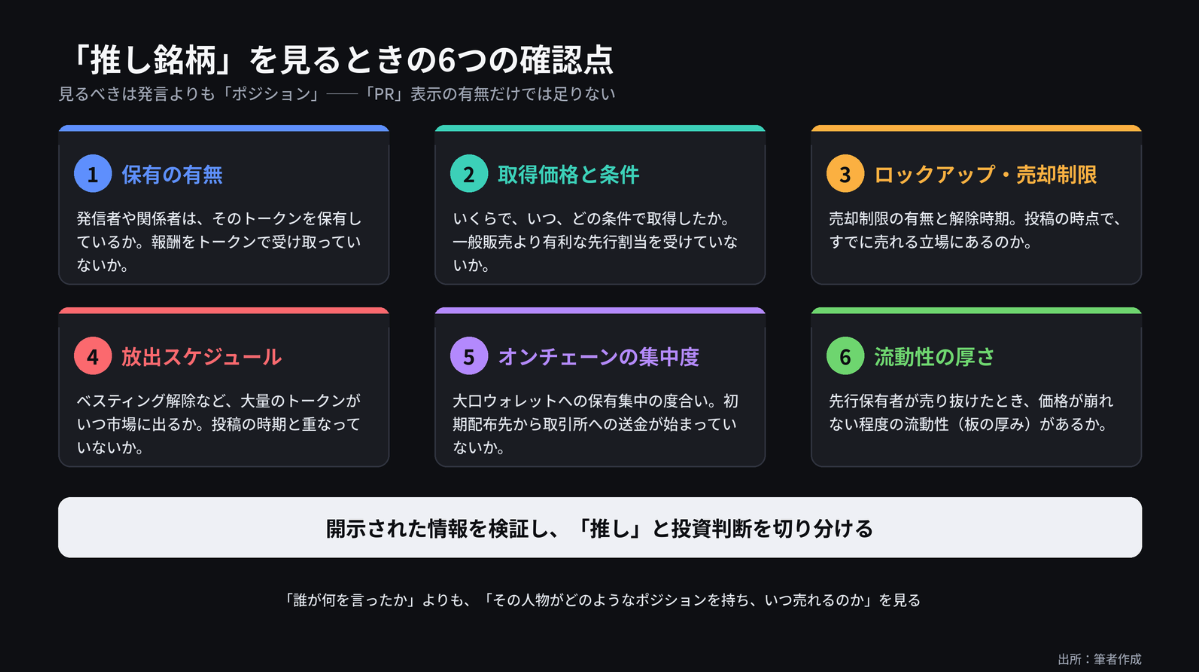
Whether the narrative shifts from the "blockchain revolution" to "DeFi," "NFTs," or today’s "meme coins" and "consumer products," the underlying formula remains unchanged: use hype to rally buyers, allowing early holders to exit. Verifying disclosed information for yourself and separating a promoter's "top pick" from your own investment decisions remains one of the simplest, cheapest, and most powerful defenses for protecting your assets in the crypto market.
(Written on August 29, 2026)
Image courtesy of Kasao Nishi
Bitcoin breaks below the $60,000 mark to hit a new YTD low (June.6, 2026 | Column)

