
※This article is intended for informational purposes and does not constitute a recommendation to use any specific exchange or to buy or sell cryptocurrencies.
Recently, in the cryptocurrency market, decentralized exchanges (DEXs) that allow futures trading on blockchain are gaining prominence. Leading the charge is Hyperliquid, the first DEX to rank among the top 10 global futures exchanges. In 2026, while Bitcoin (BTC) experienced a significant decline, Hyperliquid's native token, HYPE, reached an all-time high in September, and spot ETFs (Exchange-Traded Funds) are being traded in the United States.
However, it also faces unique risks, such as its operational structure divided among a development company, a foundation, and validators, and its regulatory stance without any national approvals. This article will organize the development organization and mechanism of Hyperliquid, its price trends, regulations, and future roadmap, and explain the prospects and risks of HYPE.
HYPE is the native cryptocurrency of Hyperliquid's proprietary blockchain. Hyperliquid's strength lies in allowing users to trade perpetual futures with speed and usability akin to centralized exchanges, without requiring users to deposit assets with the operator.
The price rose from approximately $22 at the beginning of 2026 to an all-time high of about $98 on September 23. This increase occurred amid significant declines in Bitcoin and Ethereum (ETH), and in May, spot ETFs were listed consecutively in the United States. The mechanism of buying back HYPE with approximately 99% of transaction fees has also attracted investor interest.
However, it has weaknesses not found in other major tokens, such as the lack of approval from any regulatory authority, reliance on a small number of validators, and the ongoing monthly token releases to the development team.

Hyperliquid is operated by several organizations, including the development company Hyperliquid Labs, the Hyper Foundation, and validators that verify the network. Let's first clarify the development history and the relationships between these entities.
Hyperliquid was developed by Hyperliquid Labs, founded in 2022 by Jeff Yan and others. Yan studied mathematics and computer science at Harvard University and ran the cryptocurrency market-making firm Chameleon Trading.
The development was triggered by the collapse of the major centralized exchange FTX. Yan and his team aimed to build an exchange that combines the performance of centralized exchanges with the transparency of blockchain.
Hyperliquid Labs is based in Singapore and has progressed its development entirely with self-funding, without any venture capital investment. The team consists of about 11 elite members.
The development and operation of Hyperliquid involve the following main organizations:
Organization | Role |
Hyperliquid Labs | Development company established in 2022. Based in Singapore, responsible for blockchain and exchange development |
Hyper Foundation | Foundation. Receives 6.0% of the total supply as an operational budget at issuance and operates 5 of the validators |
Validators | Entities that stake HYPE and perform network validation. As of June 2026, there are 27 |
Hyperliquid Policy Center | Policy advocacy group established in Washington in February 2026 with funding from the Hyper Foundation |
HIP-3 Market Creators | External operators that establish proprietary futures markets using a certain amount of HYPE as collateral |
The significant influence of the foundation is inseparable from discussions about decentralization. The validators operated by the foundation hold about 49% of the staked HYPE. There is persistent criticism that decentralization is being sacrificed for performance.
In March 2025, when the token JELLY was suspected of market manipulation, validators halted trading in a short time and settled at prices significantly lower than the market price. This response was criticized for intervening in the market with a small group despite claiming to be decentralized.
On the other hand, the operation without reliance on venture capital and the distribution of most tokens to users have been highly praised by the community as "the fairest launch." Concerns about decentralization coexist with praise for fairness.
Over the past year, Hyperliquid has rapidly expanded its connections with traditional financial markets.
• Spot ETFs: In May-June 2026, 21Shares' "THYP," Bitwise's "BHYP," and Grayscale's "HYPG" were successively listed in the United States
• Treasury Companies: Nasdaq-listed Hyperliquid Strategies (PURR) is accumulating HYPE as a financial asset. As of the end of June 2026, it holds approximately 29.3 million HYPE and continues to increase its holdings
• Trading of Traditional Assets: It also handles stocks and commodity futures, and The Wall Street Journal reported that it serves as a platform for investors who wish to trade on weekends or after hours
The development funding for Hyperliquid is covered by self-funding and token allocation, not by venture capital. At issuance, 23.8% of the total supply was allocated to the development team (core contributors), and 6.0% to the operational budget of the Hyper Foundation.
The majority of the fees earned by the exchange are designed to be used for buybacks of HYPE. The direct link between the exchange's earnings and token demand is a significant difference from typical exchanges.

HYPE is a cryptocurrency that began issuance at the 'Genesis Event' on November 29, 2024, with a fixed maximum supply of 1 billion HYPE. As of October 2026, the circulating supply is about 222.4 million HYPE, accounting for approximately 22% of the maximum supply.
• Staking: Validators participate in network validation by staking HYPE. General holders can also stake HYPE to earn rewards, with an annual yield of over 2%.
• Transaction Fee Discounts: Exchange fees are discounted based on the amount of staked HYPE.
• Gas Fees: Used as fees for applications on the Ethereum-compatible smart contract platform 'HyperEVM'.
• Market Establishment Collateral: Under HIP-3, businesses opening their own futures markets must deposit a certain amount of HYPE as collateral.
A distinctive feature of HYPE is that no allocation is made to VCs or exchanges, with about 70% of the total supply distributed to the community. The main distribution at issuance is as follows.
Distribution Target | Percentage | Details |
Future Rewards & Incentives | 38.888% | Reserved for future community rewards |
Genesis Distribution (Airdrop) | 31.0% | Distributed free to approximately 94,000 initial users. All unlocked at issuance |
Development Team (Core Contributors) | 23.8% | Distributed gradually after a one-year lock |
Foundation | 6.0% | Operating budget for Hyper Foundation |
Others (Grants, etc.) | Approximately 0.3% | Support for the ecosystem |
The November 2024 airdrop became a hot topic as many recipients gained significant profits, being dubbed 'one of the largest airdrops in history'.
Meanwhile, the development team's allocation saw its first distribution in November 2025, with subsequent distributions on the 6th of each month starting January 2026. On October 6, 3.75 million HYPE (worth approximately $330 million) was distributed and sold entirely to a single institutional investor via OTC (over-the-counter) trading.
HyperLiquid operates on a proprietary blockchain (Layer 1) specifically designed for trading, rather than utilizing existing blockchains. The core mechanisms are as follows.
Mechanism | Role |
HyperBFT | A proprietary consensus algorithm. Block generation takes approximately 0.07 seconds, capable of processing over 100,000 orders per second |
HyperCore | A trading engine that directly incorporates order books and futures trading mechanisms on the blockchain |
HyperEVM | An Ethereum-compatible smart contract platform allowing external developers to build applications |
HIP-3 | A mechanism allowing external businesses to establish their own futures markets with a certain amount of HYPE as collateral |
Orders are reflected almost instantly, with no gas fees for placing or canceling orders. Only transaction fees apply to trades, and futures are settled in USDC. Users connect their wallets directly for trading, eliminating the need to deposit assets with a centralized exchange.
The primary mechanism supporting HYPE's value is the buyback through the 'Assistance Fund'. The process is as follows.
1. Users pay fees with each transaction
2. The majority of the fees (approximately 99%) are allocated for buybacks
3. The Assistance Fund automatically buys back HYPE from the market
4. The bought-back HYPE is treated as burned in official documentation
This mechanism is akin to a public company's 'share buyback'. As of October 13, 2026, the fund has accumulated approximately 48 million HYPE (worth about $3.95 billion).
Additionally, since August 26, about 90% of the interest earned from USDC reserves has also been allocated for buybacks and burns. The more active the trading, the more buybacks occur, directly linking HYPE's price to the exchange's performance.
Current Price: Approximately $81 (as of October 16, 2026, CoinMarketCap)
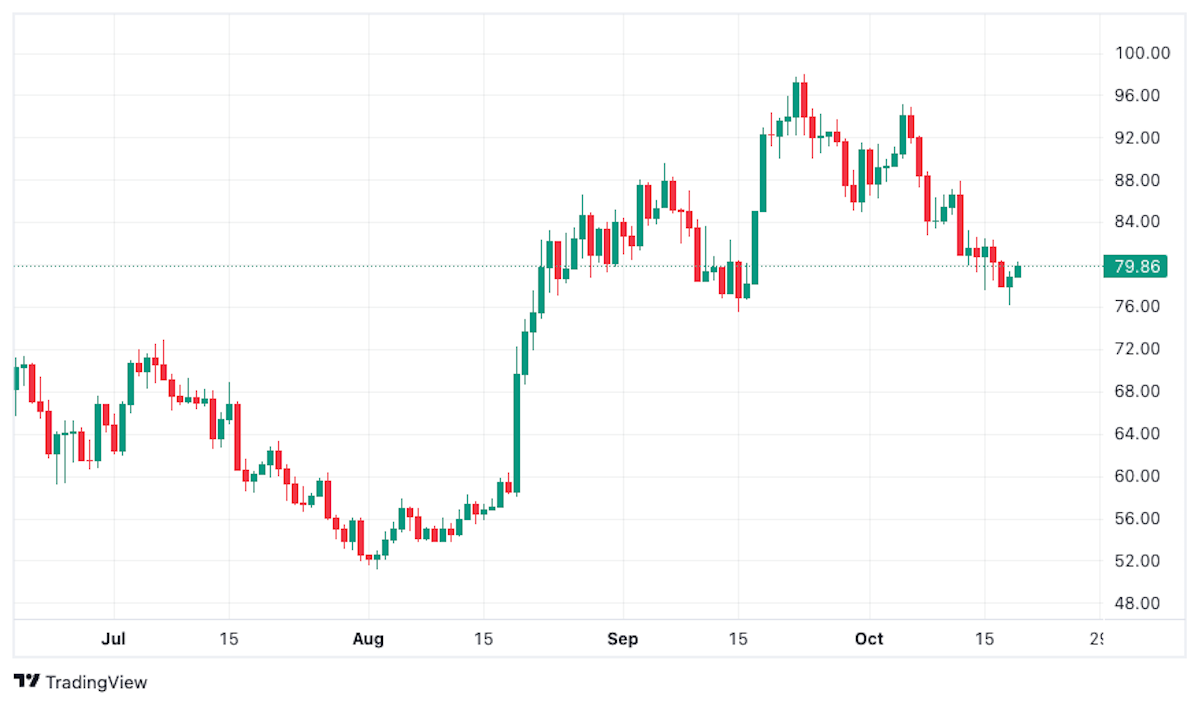
HYPE price trends (in USD, January to October 2026). Prices at key reported points, not continuous daily data.
HYPE rose from approximately $22 at the beginning of 2026, buoyed by the U.S. ETF listing in May and statements by U.S. President Donald Trump in August, reaching an all-time high of about $98 on September 23. It was one of the few major assets to multiply in value year-to-date, even as Bitcoin significantly declined from its peak.
However, since October, adjustments have occurred due to token distributions to the development team, sales by large holders, and higher-than-expected U.S. inflation indicators. The price, which was in the low $90s on October 6, fell to around $81 by the 16th.
When considering HYPE's potential for growth, the following factors are noteworthy.
• Continuous Buybacks from Fees: Nearly all transaction fees are allocated to HYPE buybacks, increasing buying pressure as trading volume grows.
• Demand from ETFs and Treasury Companies: Three U.S. HYPE ETFs incorporate staking rewards. Bitwise's head of research noted strong investor interest in the company's HYPE ETF.
• Expectations for U.S. Market Entry: On August 19, 2026, President Trump stated that the CFTC chairman is working to welcome Hyperliquid to the U.S. in a "fully legal manner." HYPE rose about 17% in one day.
• Expansion into Traditional Asset Markets: Through HIP-3, futures linked to stocks, crude oil, gold, and pre-IPO company shares are being added. Increased trading beyond cryptocurrencies broadens revenue sources.
• Expansion of Listings on Major Exchanges: HYPE is increasingly listed on major centralized exchanges, broadening its investor base.
Price forecasts vary among experts. Some predict a range of $40 to $120 for 2026, while technical analysis suggests $79 to $80 as the immediate support level, with potential for further decline if breached. Given the fluid assumptions, these should be used as guidelines, with final decisions made independently.

The regulatory challenge for HyperLiquid centers on it being a "futures exchange not directly supervised by any national regulatory authority." While futures trading is heavily regulated in many countries, HyperLiquid allows anyone to trade by simply connecting a wallet, without KYC (Know Your Customer) procedures. Although the official website restricts access from the U.S., it has not received regulatory approval.
As of October 2026, no registered cryptocurrency exchange in Japan handles HYPE. HyperLiquid itself is not a registered entity with the Financial Services Agency.
In Singapore, where Hyperliquid Labs is based, the Monetary Authority of Singapore (MAS) placed HyperLiquid on its "Investor Alert List" on June 26, 2026. This list is intended to inform users about unlicensed entities, not to impose bans or sanctions. HyperLiquid has stated that it has never claimed to be licensed by MAS.
In October, it was reported that MAS acknowledged HyperLiquid's decentralized nature, placing it outside its regulatory jurisdiction.
In May 2026, it was reported that CME Group, one of the world's largest futures exchanges, and ICE, the parent company of the New York Stock Exchange, were lobbying the CFTC and Congress to bring HyperLiquid under federal oversight. They argued that the anonymous, 24-hour trading environment could be exploited for market manipulation and sanctions evasion, particularly highlighting the surge in oil-related futures trading amid Middle Eastern tensions.
In response, the Hyperliquid Policy Center argued that since all transactions are publicly available on the blockchain in real-time, market manipulation is less likely.
Meanwhile, efforts to incorporate HyperLiquid into the regulatory framework are underway in the U.S. On August 19, President Trump made the aforementioned statement, and in September, the parent company of major U.S. exchange Kraken announced plans to offer a regulated HyperLiquid futures market using HIP-3. However, specific timelines or applications for HyperLiquid's approval have not been disclosed.
If a formal framework is established in the U.S., it could attract a vast customer base from the American market, though mandatory KYC could compromise its current ease of use. Conversely, if regulatory tightening precedes, it could significantly impact trading volumes and HYPE prices.

HyperLiquid is expanding its business from a cryptocurrency futures exchange to a "foundation of on-chain finance" that encompasses stocks, commodities, and prediction markets.
Under HIP-3, futures for stocks, oil, gold, and more have been successively added, growing to hold approximately $4 billion in open interest by 2026. Futures linked to SpaceX's stock price, which was listed in June, also gained popularity.
• Launch Date: Officially launched on May 2, 2026
• Mechanism: Settlements are made in binary outcomes of 0 or 1 based on future events
• Competitors: Competes with Kalshi and Polymarket
• Future Plans: Plans to allow anyone to open a market by depositing 1 million HYPE
The stablecoin "USDH" operated by Native Markets is being phased out, with USDC, officially deployed by U.S. Coinbase, becoming the central settlement currency. As previously mentioned, about 90% of the interest from USDC reserves is allocated for HYPE buybacks.
In the U.S., following ETF listings in May and June, Kraken's parent company announced plans to offer a regulated HyperLiquid futures market to U.S. customers. The number of publicly listed companies holding HYPE as a financial asset is increasing, broadening the pathways for capital inflow from traditional financial markets.
HyperLiquid is the largest decentralized futures exchange, but competition is intensifying. Since late 2025, "Aster," closely associated with Binance, and "Lighter," which promotes zero fees, have rapidly increased trading volumes through reward programs, at times surpassing HyperLiquid's market share.
However, trading driven by rewards is not sustainable. In terms of open interest, which better reflects actual market conditions, HyperLiquid significantly outpaces its competitors. The focus moving forward will be on maintaining trading volume share while sustaining fee income.

While the buyback mechanism and ETF listing provide strong support, the price of HYPE is significantly influenced by regulatory decisions and the token release schedule.
The limited number of validators, allowing market intervention by a few, is a weakness for a DEX. As seen in the JELLY incident of March 2025, emergency interventions can lead to user distrust. Additionally, trades aimed at market manipulation or large-scale forced liquidations pose a risk of financial loss to the exchange.
Registered operators in Japan do not handle HYPE, limiting domestic purchase options. Using unregistered overseas operators or HyperLiquid directly means users cannot rely on domestic legal protection in case of issues. If regulatory tightening in countries like the U.S. leads to broader usage restrictions, it could reduce trading volume and weaken HYPE buybacks.
Only about 22% of HYPE is in circulation. Allocations to the development team are released monthly, with approximately $330 million distributed on October 6 (all of which was sold OTC to institutional investors). Movements of large holders transferring HYPE to exchanges have been observed, potentially weighing down the price.
While HYPE has risen several times since the beginning of the year, it is not uncommon for it to drop more than 10% in a week. It is reported that leverage trading on HyperLiquid itself amounts to about $1.66 billion as of October 13, making forced liquidations likely if the market reverses. Investors should start with small amounts and keep an eye on regulatory news and token release schedules.

HyperLiquid is a decentralized exchange (DEX) that combines the performance of centralized exchanges with the transparency of blockchain, developed by Hyperliquid Labs without relying on venture capital. HYPE is designed to directly link the exchange's performance with its price through a buyback mechanism using approximately 99% of transaction fees.
In 2026, the company plans to list an ETF in the United States, expand its business through HIP-3 and HIP-4, and has seen positive developments such as reaching an all-time high in September. However, it has not received approval from any regulatory authorities, faces regulatory demands from major U.S. exchanges, and is listed on Singapore's warning list. The influence of validators concentrated in the foundation and monthly token releases could also impact its price.
While the design of returning the exchange's earnings to the token is rare, it is built on a regulatory gray area. Investors should assess the regulatory landscape and the development organization's trends to determine their risk tolerance and engagement strategy.

As of October 2026, there are no registered cryptocurrency exchange operators in Japan handling HYPE. Since availability may change, please check the list of registered operators by the Financial Services Agency or the publications by JVCEA (Japan Virtual and Crypto Assets Exchange Association).
Profits from selling assets or futures trading are generally subject to comprehensive taxation as miscellaneous income (up to about 55% including local taxes). The approximately 20% separate self-assessment taxation expected to start as early as 2028 will likely apply to transactions of cryptocurrencies handled by domestic registered operators, making it highly probable that HYPE, not handled domestically, will be excluded.
While the concept of buying back one's own tokens with earned money is similar, HYPE holders do not have legal rights to voting or dividends like shareholders. Additionally, the scale of buybacks is influenced by trading volume, so support may weaken if the market cools down.
Hyperliquid is not a business registered with Japan's Financial Services Agency, and users cannot receive protection under domestic law if issues arise during use. The Financial Services Agency repeatedly warns against overseas operators offering services to Japanese residents without registration. Leveraged futures trading, in particular, poses a risk of losing funds in a short period.