


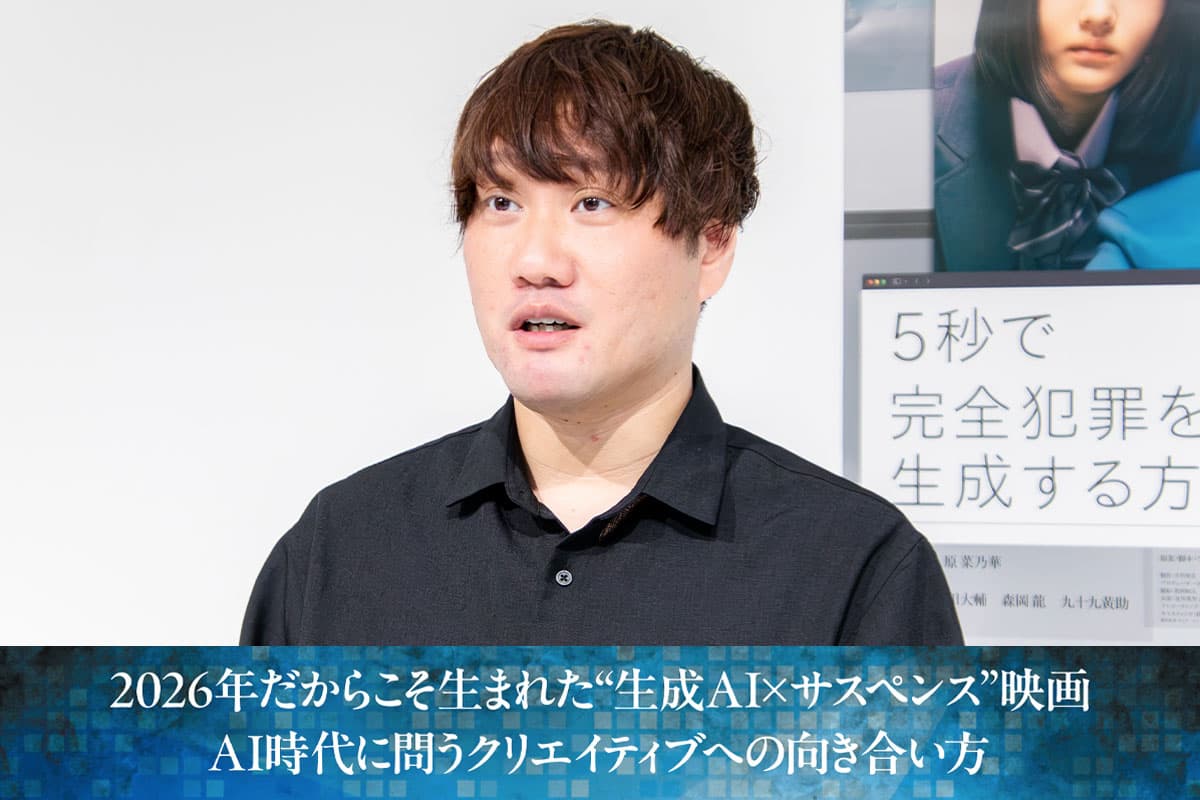
1.Birth of a Generative AI Thriller
The film How to Generate a Perfect Crime in 5 Seconds is a suspense thriller depicting a perfect crime scenario crafted via conversational AI alongside human conflict. Building on a meticulously structured plot, the direction infuses rich humanity into each character, creating a film that epitomizes the current era.
2.Meticulous Screenplay and Human-Centric Direction
Working with Michitaka Okada’s highly polished script, Director Ryota Kondo added layers such as the characters' future dreams and personal struggles. While centered on cutting-edge AI technology, the film vividly highlights raw human drama at its core, particularly family bonds and internal turmoil.
3.Creativity in the AI Era and the Human Touch
While Director Kondo views AI as a useful sounding board for brainstorming, he emphasizes that a story’s true appeal stems from human nuance and emotion. By capturing the evolving relationship between people and technology during a period of transition, this film serves as a lasting record reflecting the future of creative work in the AI era.
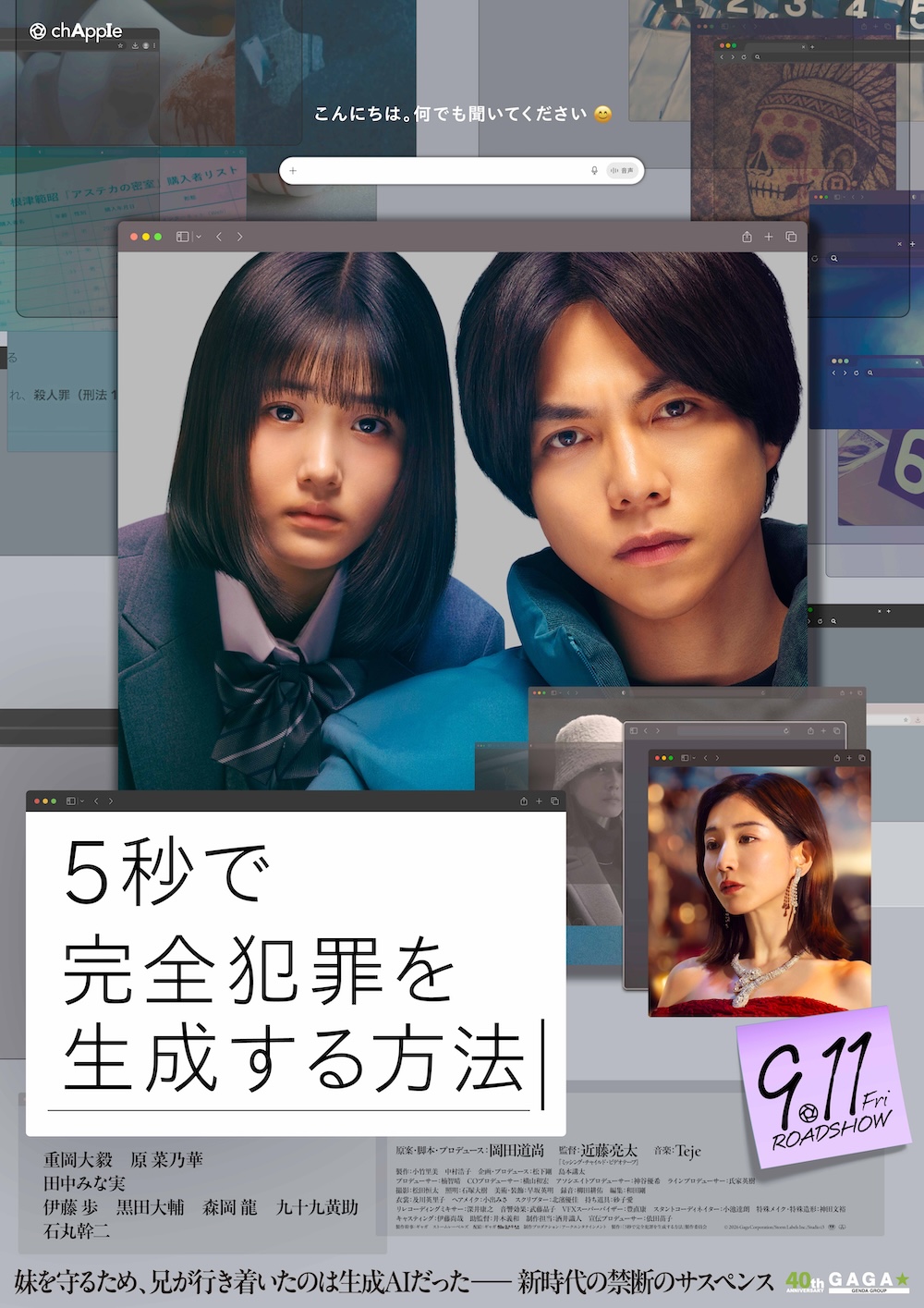
In theaters nationwide starting Friday, September 11!
Cast: Daiki Shigeoka, Nanoka Hara, Minami Tanaka
Original Story, Screenplay & Produced by: Michitaka Okada
Directed by: Ryota Kondo
Distributed by: GAGA
©2026 Gaga Corporation/Storm Labels Inc./Studio i3
Official Website: https://gaga.ne.jp/5byodeseisei/
To save his younger sister Saki (Nanoka Hara) after she accidentally commits murder, her older brother Wataru (Daiki Shigeoka) asks a conversational generative AI how to pull off the perfect crime in an attempt to cover up the incident. This new-era suspense film interweaves the meticulous scenario guided by the AI, unexpected turn of events, and intense human conflict—making it a must-watch entertainment experience of 2026.
──What was your initial impression when you read the script for the film How to Generate the Perfect Crime in 5 Seconds?
Ryota Kondo (hereinafter "Kondo"): I felt it was incredibly contemporary. With my previous projects, even if a screenwriter ultimately penned the script, the initial concepts often originated from my own ideas. However, the script written by Michitaka Okada possessed a kind of appeal I never would have come up with myself—in everything from characterization and narrative flow to the handling of themes.
──Your films often feature a distinctive use of eerie suspense—the feeling that "something might be there"—and silent pauses. While those elements are present here too, where did you perceive a "gap"—in a positive sense—between your approach and that of the screenwriter, Mr. Okada?
Kondo": Even regarding the interpretation of a single character, I felt we were looking at things from quite different perspectives. I usually work on horror films, and my content doesn't typically lean toward mainstream entertainment.
On the other hand, Mr. Okada seems to craft characters designed for mass-market entertainment. So, the process involved aligning my own view of humanity with the solid structural framework and dry, pragmatic tone he had established.
.jpg?w=1200&h=800)
──It seems like a process where Mr. Okada built the character profiles and you breathed life into them; what did you focus on during that stage?
Kondo": Ultimately, my job as a director lies in guiding the actors—taking the script and character settings and helping them internalize those elements to create a compelling, human portrayal. Since the story’s mechanics were already perfectly crafted, I focused on infusing it with my own perspective on human nature. In practice, I often added subtle elements—aspects not explicitly mentioned in the story but which I felt might exist beneath the surface.
Although this film deals with AI, at its core, I believe it is a story about humanity. I interpreted this as a story that explores what the characters are sacrificing and what they fear losing.
Regarding "what they fear losing," the sibling relationship is a key factor. I have siblings myself, and I know that the desire to cherish one's family can sometimes conflict with the importance placed on one's career. Even with the younger sister, Sara, while she certainly values her older brother, Wataru, I felt it was important to establish that she has her own dreams as well.
Initially, there was no specific plan for Sara to have a future dream. I proposed the idea and pushed to strongly emphasize her ambition to become a pastry chef.
Although it doesn't significantly alter the main plot, I believed that conveying a sense of each character's own "time"—their personal lives and journeys—would enhance the story's appeal. That is why I made numerous suggestions for each character, focusing on elements that would add a touch of humanity to them.
──Did you face any particular challenges during filming, or did you make any new discoveries while working on a project involving generative AI that you think you can apply to future work?
Kondo: There were many challenges, but since this was a feature-length film, the sheer scale—which was vastly different from my debut film, Missing Child Videotape—was a major hurdle.
We shot a project of this magnitude with essentially the same core team as the previous film, maintaining a workflow that felt like an extension of making an independent movie. Looking back, I’m amazed the producers allowed us to do that. However, since we weren't exactly a team with extensive experience, we had to gradually figure out what was feasible and what wasn't.
Although the shooting schedule was about three times longer than the previous film's, we didn't end up having as much breathing room as I had imagined. Even so, I discovered—surprisingly—that there were aspects no different from producing a short-term project; that was a new insight, and I’m glad I had the experience.
.jpg?w=1200&h=800)
──What are your thoughts on the significance of exploring generative AI as a theme in this film?
Kondo: Personally, I use AI casually for things like seeking advice, bouncing ideas around, or discussing project concepts. That’s precisely why I hope this film helps bridge the gap between people and this cutting-edge technology.
I also feel that this might be a "transitional" film. Some of the technologies depicted in the story fall into a realm that, strictly speaking, isn't quite achievable with current technology.
On the other hand, there are parts where I think, "This might not even be surprising anymore." So, the impression it leaves could be completely different if viewed five years from now—or even next year. It might end up being a film that serves as a record of the technological evolution process when looked back upon later.
──While AI is expected to enhance convenience across all sectors, the creative field faces various challenges, such as copyright and ethical issues. Given this landscape, what are your thoughts on how to approach creativity in the AI era and how to coexist with AI?
Kondo: I do utilize AI myself, though there are certainly many things to be cautious about. I believe that—at least for the time being—there are many instances where using AI without restriction for the final output isn't appropriate.
However, just as with the advent of smartphones or the internet, establishing a consensus on how to handle new technologies takes time. So, I don't immediately view AI as scary or inherently bad, nor do I think we should simply go all-out and use it for everything.
For me, the primary use right now is akin to "channel surfing." I once heard a story about the manga artist Osamu Tezuka: whenever he hit a wall while working on a manuscript, he would turn on the TV and just flip through channels endlessly. Apparently, he would switch channels without any specific reason, but I find that watching movies while working on a project can spark new ideas in a similar way.
AI plays a similar role. To be honest, if I ask it for advice on a project, the answers aren't particularly profound. Current AI tends to output things I already know—stating the obvious—but it serves as an excellent sounding board for triggering a phrase or keyword that acts as a creative hook.
That said, I don't feel it's realistic to have AI write a full script as the final output. While it might reach a certain level of competence, there is something more interesting about work that incorporates a human creator's unique quirks and the mood of the moment. I think it will still take time for AI to truly express "humanity."
.jpg?w=1200&h=800)
──Finally, could you tell us the highlights of How to Generate the Perfect Crime in 5 Seconds and share a message with your readers and fans?
Kondo: The characters in this work have become truly compelling thanks to the performances of the actors. At its core, the story unfolds as a piece of entertainment centered on the concept of a "perfect crime committed using AI"—an idea that could only have emerged in the present day. I believe this is the kind of work that could only have been created in 2026, and since there are so many different angles from which to enjoy it, I would be delighted if you came to the theater to see it.
.jpg?w=1200&h=800)
◉ Ryota Kondo
Born in 1988. After winning awards two years in a row at the Japan Horror Film Awards, they made their commercial debut with the feature film Missing Child Videotape. Known for their unique approach to horror direction and the effective use of silence, they are directing the upcoming film How to Generate a Perfect Crime in 5 Seconds.
Generative AI can be upgraded to become an autonomous AI agent

