



On July 12, 2026, the 'Japan Blockchain Week Summit 2026' (JBWS 2026, hereafter referred to as JBWS), organized by the Japan Blockchain Week Association, was held at Shibuya Stream Hall in Tokyo.
JBWS is one of the main events of 'Japan Blockchain Week 2026,' Japan's largest Web3.0 event week, which takes place from July 1 to 15, primarily in the Tokyo metropolitan area.
The 2026 JBWS was sponsored by Bitmine Immersion Technologies (hereafter referred to as Bitmine), attracting over 1,000 participants, including entrepreneurs, developers, investors, and policymakers from both domestic and international spheres. The venue hosted multifaceted discussions on cutting-edge topics such as the future of Web3.0, the integration of AI and cryptocurrencies, the evolution of on-chain economies, and the current state of NFTs.
Now in its 8th year, Japan Blockchain Week has firmly established itself as a bridge connecting the Japanese and global crypto ecosystems. This article reports on the key sessions of the day that caught the editorial team's attention.
The opening session, 'Opening Talk & Fireside Chat,' featured a discussion between Mai Fujimoto, representative of Japan Blockchain Week, and Arisa Toyosaki, who was appointed CEO of Binance Japan as of July 1st. This session delved into the future vision that Binance Japan is crafting under its new leadership.

Toyosaki, who majored in computer science at university, discovered the potential of blockchain technology while studying decentralized systems.
After graduating, she worked as a derivatives trader at a foreign securities firm and was involved in the development and product strategy of search products at Google. She fully entered the DeFi sector in 2021, leading the development of the DeFi derivatives market 'Cega Finance' over the past five years, completing a business sale in 2025.
Toyosaki chose to lead Binance Japan from among numerous offers, citing 'the social implementation of blockchain technology' as her reason. Despite achieving certain results in the DeFi sector, she felt the industry's scale was a challenge and decided that broader dissemination of technology was necessary for social implementation.
She expressed confidence that Binance Japan, with its license from Japan's Financial Services Agency and a solid foundation of trust, could 'unite the world's largest liquidity with trust in Japan to advance its vision.'
Toyosaki then presented the unique strengths of Binance Japan, which continues to expand in Japan, and outlined the 'three pillars' for future growth. The company currently handles 66 assets, the most in the country, and has recorded the highest trading volume in yen for Bitcoin (BTC) and Ethereum (ETH) over the past six months.
The three pillars of the growth strategy are as follows:
Finally, Toyosaki assessed the current cryptocurrency market as being 'at a turning point towards mass adoption.' She stated that upcoming tax and regulatory reforms in Japan would significantly support user behavior, emphasizing that despite the industry's volatility, maintaining trust in technology and a clear purpose would present excellent opportunities as the market grows.
She praised the participants as early adopters and made a strong call to build the future of the industry together.

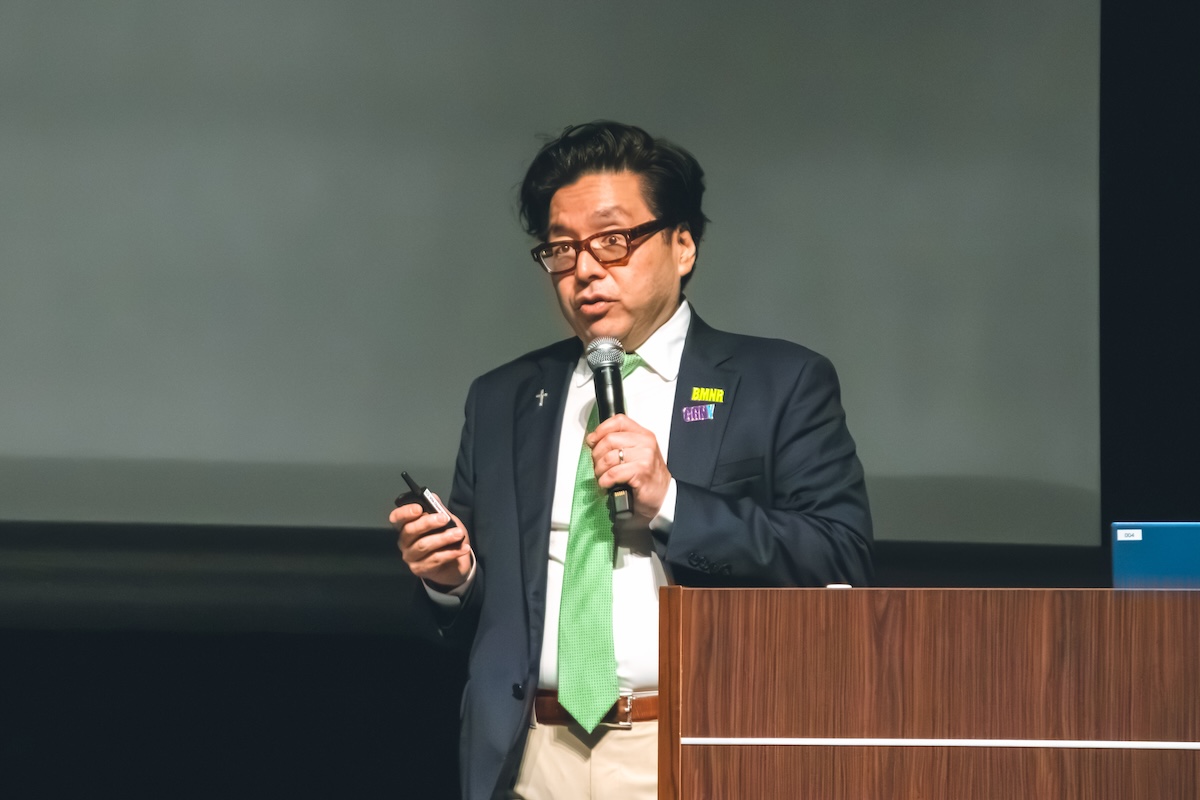
In the special keynote, Tom Lee, co-founder of U.S.-based Fundstrat and Chairman of Bitmine, took the stage.
Lee shared his belief that 'Ethereum is the solution to the uncanny valley of wealth,' while expressing a cautiously optimistic outlook on the bearish market sentiment in the medium to long term.
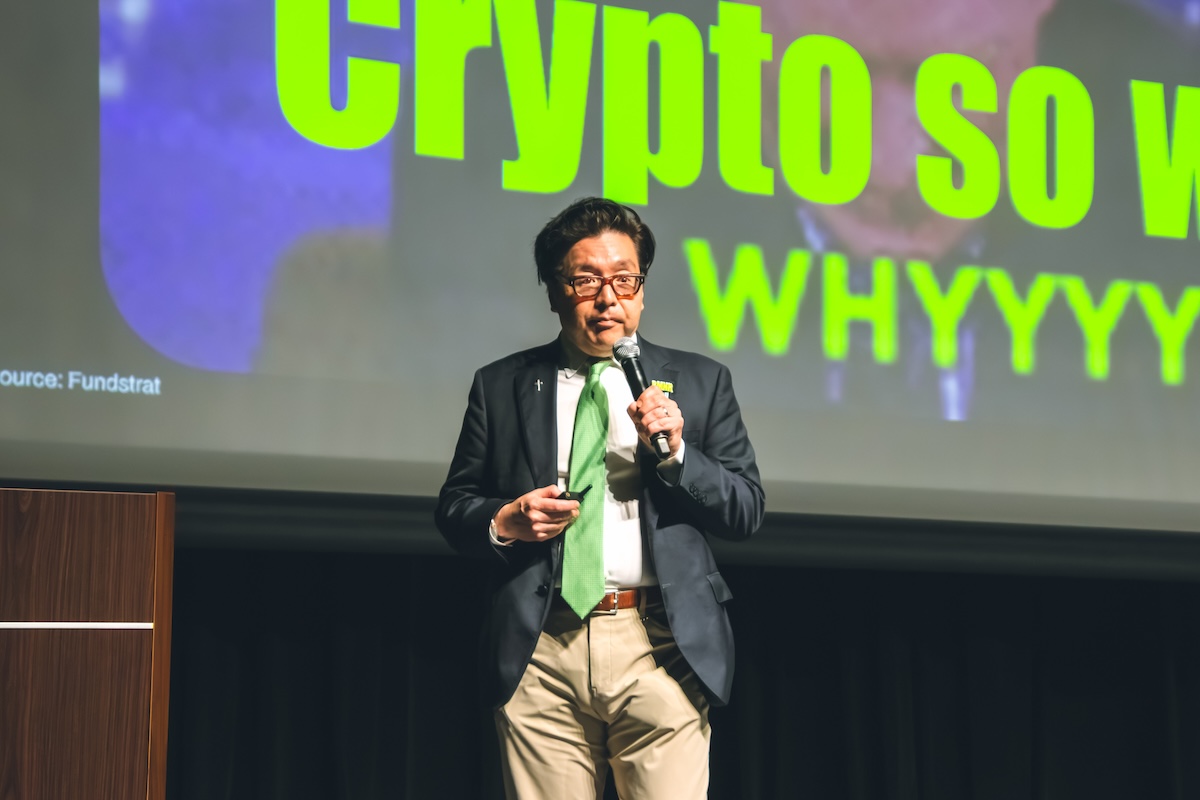
At the beginning of the session, Lee analyzed the challenging macroeconomic environment in the current cryptocurrency market. He highlighted concerns such as the Federal Reserve's shift from a dovish to a more hawkish monetary policy stance, the stagnation of the Clarity Act's legislation in the U.S., and the temporary suppression of interest in cryptocurrencies due to excessive capital concentration in the AI sector (AI FOMO).
However, he emphasized, citing technical analysts, that 'market sentiment is at a bottom, and bearish views are being formed at the bottom.' Quoting renowned investors Benjamin Graham and Warren Buffett, he stated that 'even if the market temporarily ignores a company's success, it will ultimately prove it,' suggesting that a time will come when substantial growth is rightfully recognized beyond short-term price fluctuations.
Lee expressed strong expectations for Ethereum's growth potential, citing the expansion of tokenization projects by Wall Street, the rapid growth of Robinhood's Layer 2 chain, and overwhelming support from developer communities worldwide, analyzing that 'the shift from traditional financial infrastructure to on-chain is accelerating.'
Drawing parallels with the history of Amazon and NVIDIA, which expanded their business scale and saw stock prices soar after long periods of stagnation, he stated that Ethereum is currently in a transformative phase towards 'Ethereum 2.0.'
Furthermore, he predicted the 'fusion of AI and cryptocurrencies,' where blockchain will function as a trust foundation to overcome the 'uncanny valley' phenomenon in the relationship between humans and AI in a future where autonomous AI agents rise to create wealth instead of humans.
Finally, he explained Bitmine's efforts, which acquired approximately 5.74 million ETH within a year of its establishment (as of the time of the presentation) and built a massive staking network, concluding the lecture with Charlie Munger's adage, 'Great wealth is born from the time spent patiently waiting, not from frequent trading.'
The panel discussion titled 'Zero-Knowledge Proof for Privacy — Essential Latest Technology for Asset Management' brought together experts at the forefront of privacy protection technology development.
Moderated by Ikuma Rokubu from Tané, the panel featured Alan Scott from RAILGUN, Reona Hioki from INTMAX, and Tomonori Adachi from Nyx Foundation. They delved into the fundamental question of why privacy is indispensable in public blockchains, which have developed with transparency as a premise.
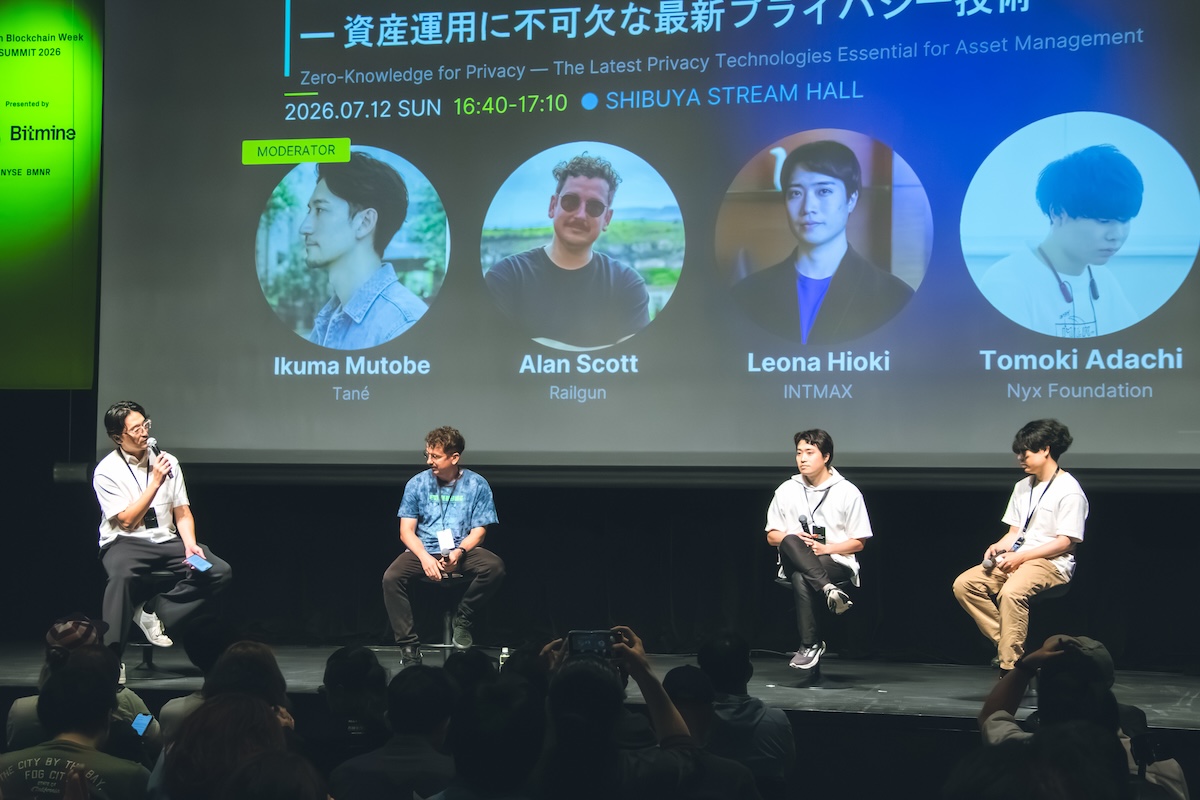
Panelists pointed out that privacy and security, which are naturally guaranteed in traditional finance, are significantly lacking in DeFi (Decentralized Finance) and everyday transactions on public chains.
The current situation, where addresses and transaction histories are fully public, poses risks such as personal safety, the revelation of salary disparities, and the identification of everyday purchasing trends.
In the financial realm, the monitoring and targeting of institutional investors' trading strategies and asset holdings present a critical barrier to the full-scale entry of large capital.
In response, solutions like RAILGUN and INTMAX, utilizing ZKP (Zero-Knowledge Proof), were argued to be essential infrastructure that ensures confidentiality while maintaining transparency and verifiability.
The discussion further extended to maintaining composability within the ecosystem, the future of AI agents autonomously conducting transactions, and the risks of cryptanalysis in anticipation of the rise of quantum computers.
As AI advances, enhancing tracking and heuristic analysis, the importance of incorporating a robust privacy layer across the protocol to prevent data leakage from side channels like IP addresses and RPC calls, and to support quantum-resistant cryptography, was affirmed.
Panelists recommended immediate self-defense measures for users, such as regularly updating VPNs and passwords or using privacy-focused tools like Brave and Signal. They concluded the session with a shared understanding that privacy is not merely a feature to conceal transactions but a 'necessary infrastructure layer' supporting the next-generation digital society across all domains, including DeFi, payments, AI, and quantum resistance.
The JBWS 2026 strongly impressed upon attendees not only discussions on market institutionalization and infrastructure development from a business perspective but also numerous sessions that presented the depth and current state of crypto culture.
At the venue, cutting-edge themes such as integration with AI and privacy technologies for institutional investors were discussed, alongside numerous valuable sessions on new use cases for NFTs, which have reached maturity after the initial boom, and community-driven on-chain culture.
The event provided a unique opportunity to rediscover the intrinsic value of blockchain and the ecosystem culture unique to Web3.0, unaffected by short-term trend fluctuations.
As the practical application of Web3.0 and the maturation of culture progress in tandem, this year's JBWS, which comprehensively captured the current state of technology and community, offered a particularly valuable opportunity amid the predominance of on-chain topics.
Image: Iolite
Startup Festival 'JAPAN IS BACK': IVS2026 Event Report
Arisa Toyosaki Appointed as New Representative of Binance Japan, Outlining "Three Pillars" Strategy

