



1. Transition to FIEA and Regulatory Harmonization
The transition of cryptocurrency regulations to FIEA will erase the boundaries between domestic and international exchanges. International players will be required to comply with the same standards, competing on a level playing field, leading to a harsh survival race focused on pure liquidity and execution power after regulatory harmonization.
2. Evolution into Financial Institutions and Influx of Institutional Funds
With the application of strict financial discipline, such as crackdowns on unfair trading and capital increases, exchanges will transform from 'exchange operators' into 'true financial institutions'. Establishing high trust and custody functions will be key to attracting substantial institutional investor funds and unlocking physical ETFs.
3. Industry Reorganization Driven by High Fixed Costs and Consolidation
The heavy fixed costs of high-level security and regulatory compliance will pressure management, strengthening the structure where large firms with capital dominate the market. Mid-sized exchanges with less resilience will be swept up in waves of consolidation and reorganization, either by specializing in niche areas or through acquisitions by traditional financial institutions.
As domestic cryptocurrency regulations enter a transition period, how will the power dynamics among exchanges change? This article organizes the essence and structural weaknesses of the competitive advantages created by regulatory asymmetry between 'domestic' and 'international' exchanges, and outlines the next contours of the industry.
There is a fundamental fact that must be understood. Providing services to Japanese residents by unregistered operators without a Japanese license constitutes a 'clear illegal act' under the Payment Services Act.
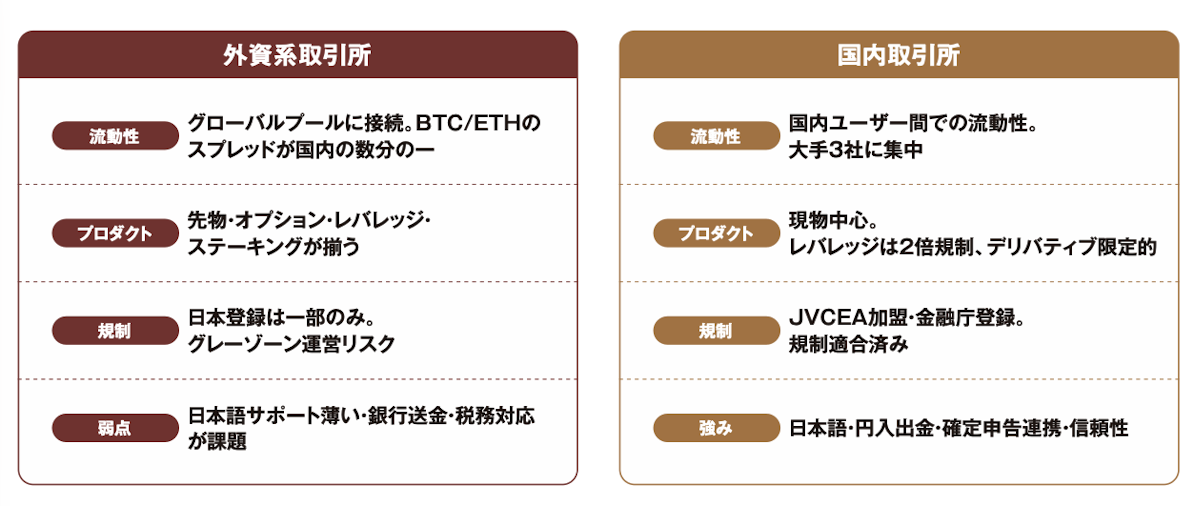
On the other hand, current laws do not have provisions to directly penalize users, placing them in a realm of 'complete self-responsibility' for risks such as hacking. For convenience, this article refers to operators registered with the Financial Services Agency as 'domestic' and unregistered operators as 'international.' Against the backdrop of this regulatory asymmetry where 'operators are illegal, users are unpunished,' both have entirely different strengths and constraints.
The advantage of international exchanges lies in their direct connection to global markets with massive liquidity and an overwhelming array of leverage and financial derivative products. Operating outside Japanese regulations, they maintain tight spreads with a vast number of participants. However, the barriers to legitimate entry into the Japanese market are high, with the unique regulatory adaptation costs in Japan being so burdensome that they forced U.S. Coinbase to withdraw, resulting in the continued presence of unregistered operators based overseas.
Conversely, domestic exchanges have leveraged strict regulatory compliance as a barrier to entry, providing immense reassurance to corporations and high-net-worth individuals. Their greatest asset is the thoroughly localized convenience, including immediate yen deposits and withdrawals in collaboration with megabanks, integration with tax filing tools, and swift Japanese language support. It is inevitable that the majority of domestic spot trading volume is dominated by the top three companies.
However, there are heavy structural constraints behind this. The leverage limit of up to 2x, the scarcity of derivative products, and the conservative screening process delaying new listings. As a result, substantial funds from risk-seeking professional traders and hedge funds seeking advanced operations are flowing out to overseas markets.

