Let's start with the facts. For the second quarter ending July 26, 2026, NVIDIA's revenue was $96.2 billion, doubling from $46.7 billion in the same period last year. The Data Center division accounted for $89 billion, a 117% increase, comprising 92.5% of total revenue. The breakdown includes $48.7 billion for "Hyperscale" targeting major cloud providers and $40.3 billion for "ACIE" aimed at AI cloud and industrial enterprises. The gross margin remained at 75.0%.
For the third quarter, NVIDIA anticipates revenue of $108 billion, assuming zero sales to China. During the earnings call, a forecast of approximately 70% revenue growth for the next quarter was also presented. While the company states that demand exceeds supply, the real question is whose pockets are funding this demand.
A data center with an initial capacity of 4.25 gigawatts, expandable to about 8 gigawatts, is being constructed in Pike County, Ohio. The development and operation are managed by SB Energy, a subsidiary of SoftBank Group. Upon completion, it will be leased to OpenAI for 20 years.
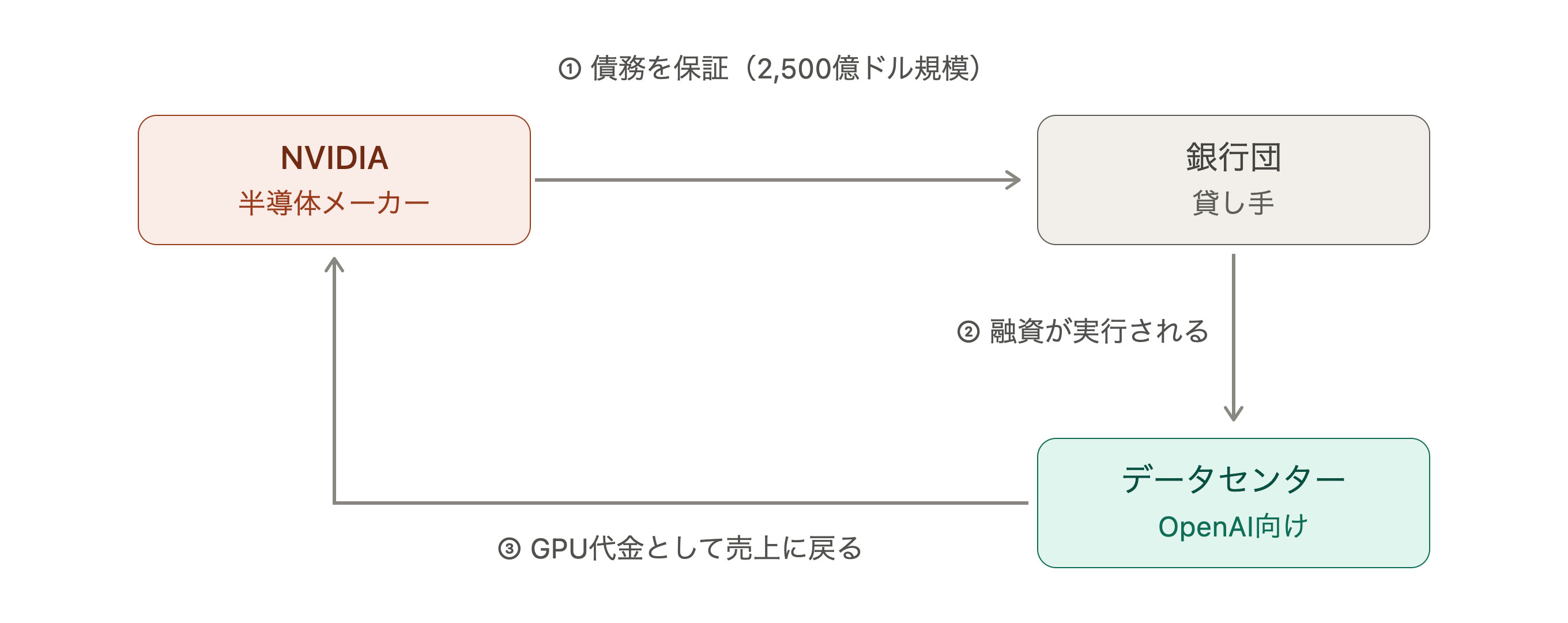
NVIDIA will be the exclusive chip supplier for this project. An SEC filing on August 17 also revealed that NVIDIA will conditionally guarantee up to $105 billion of OpenAI's lease and power payment obligations to SB Energy. NVIDIA has also invested $1.5 billion in SB Energy.
Why is a guarantee necessary? OpenAI lacks an investment-grade credit rating and is running significant deficits, making it unable to secure multi-trillion yen loans independently.
This is where the seller steps in as a co-guarantor. The guarantee facilitates the loan, the loan enables construction, and construction drives GPU sales. It's akin to a home builder acting as the guarantor for a mortgage on a house they built.
In the late 1990s, telecom equipment maker Lucent Technologies used a similar strategy, lending money to emerging telecom carriers so they could buy its products. When the bubble burst and those customers failed, Lucent lost both the sales and the loans at once. The company fell into a prolonged crisis and was ultimately absorbed through a merger with Alcatel in 2006.
NVIDIA's approach is more sophisticated than Lucent Technologies'. For CoreWeave, NVIDIA holds about a 10% stake and is obligated to purchase unsold data center capacity up to $6.3 billion. The seller assumes the customer's inventory risk.