


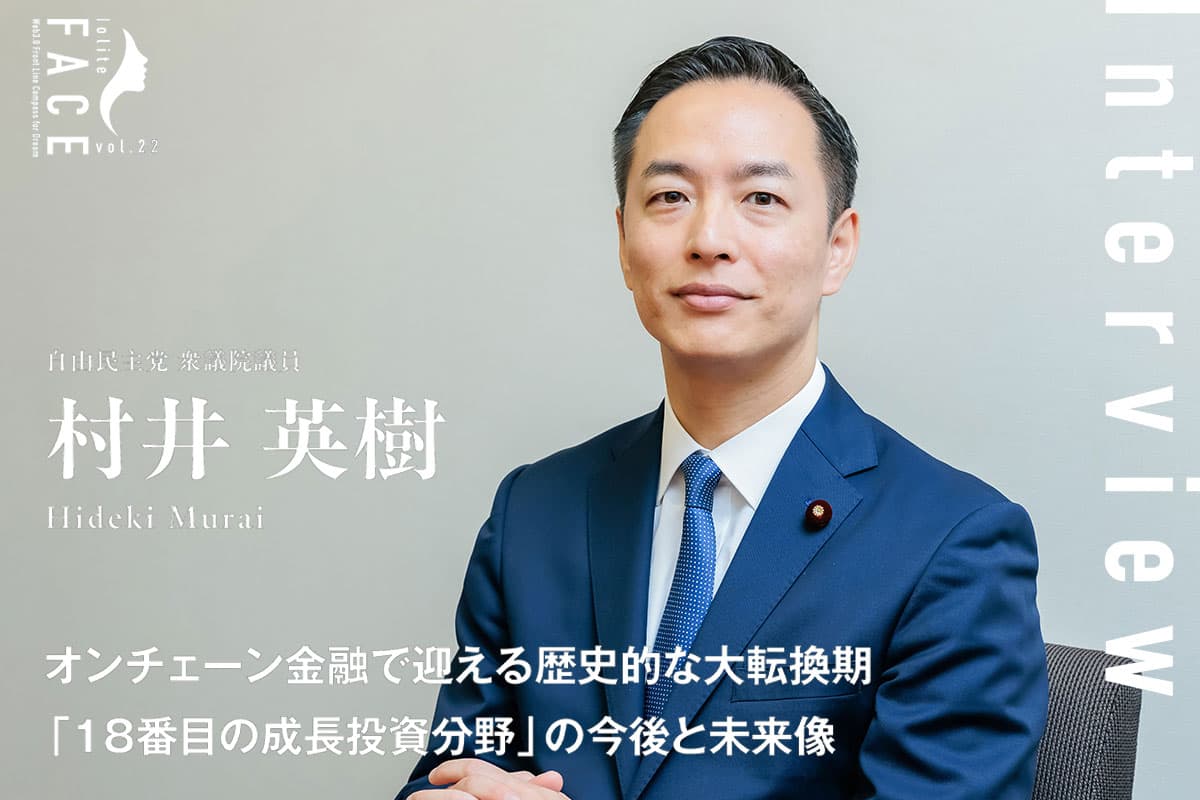
1. The '18th Growth Investment Sector' and AI Agents
The government has positioned on-chain finance alongside AI and semiconductors as a 'growth investment sector.' The future envisions a time when AI agents autonomously handle payments and contracts, with blockchain serving as the trust foundation.
2. Leading International Standards from the Asian Market
To prevent dependency on foreign platforms, Japan needs to actively participate in creating international standards. Particularly in the Asian market, where the demand for digital finance is high, Japan should aim to establish de facto standards and enhance its presence.
3. Public-Private Collaboration from System Development to Social Implementation
The era has already shifted from 'system development' to 'social implementation.' The government is considering policy support, including budgetary measures, to strongly back private enterprises in taking risks to build new payment infrastructures.
── You launched the 'Next-Generation AI and On-Chain Finance Initiative PT' and compiled recommendations within a few months. Could you share your thoughts on the focus on 'AI and on-chain finance integration' and Japan's current position compared to the international community and major countries?
Hideki Murai (hereafter, Murai): Not only am I the secretary-general of the Next-Generation AI and On-Chain Finance Initiative PT, but I also chair the Payment and Innovation Promotion PT of the Financial Research Council. Therefore, I have approached the Next-Generation AI and On-Chain Finance Initiative PT from both the perspective of the Liberal Democratic Party's Policy Research Council's Digital Society Promotion Headquarters (hereafter, Digital Headquarters) and the Financial Research Council.
I believe that blockchain, after a long period of stagnation, is now entering a full-scale practical phase in the financial sector. Observing current trends, discussions on stablecoins and tokenized deposits are accelerating globally, and financial institutions are transitioning from pilot projects to social implementation. The possibility of fundamentally renewing the payment infrastructure is becoming increasingly realistic.
Furthermore, the rapid evolution of generative AI has decisively changed the situation. Having served as the first team leader of the government's AI strategy team under the Kishida administration, I have firsthand experience of the significant impact of generative AI's proliferation.
We are entering an era where AI agents will gather information and make decisions on behalf of humans, handling actual financial transactions and contract executions. In such a scenario, blockchain, with its tamper resistance and transparency, will serve as a trust foundation, greatly enhancing the efficiency and convenience of finance.
If we fall behind this global trend, we risk becoming dependent on foreign platforms and currencies for future payment and financial infrastructure, directly impacting financial and currency sovereignty. Therefore, leveraging Japan's current strengths to lead social implementation and international rule-making is crucial.
── How do you differentiate the roles and approaches between the Next-Generation AI and On-Chain Finance Initiative PT and the Payment and Innovation Promotion PT?
Murai: The main difference lies in the approach perspective. The Digital Headquarters' Next-Generation AI and On-Chain Finance Initiative PT focuses on envisioning the future of 'AI × On-Chain × Finance,' working backward from 100 goals to create a big picture. In contrast, the Payment and Innovation Promotion PT considers the evolution of current payment systems, gradually implementing systems from 1 to 2, and 2 to 3. Both are future-oriented initiatives, but the methods of completing the picture differ.

── What conditions do you believe are necessary for Japan to lead in on-chain finance internationally, and what challenges need to be addressed?
Murai: It is essential not only to develop systems but also to actively engage in creating international standards. Finance connects across borders, so we must ensure interoperability with stablecoins, tokenized assets, and next-generation payment infrastructures advancing in the US and Europe, positioning Japan's systems as part of the global standard. The BIS (Bank for International Settlements) and major central banks are also exploring new financial architectures, making discussions between regulatory authorities and private players, as well as public-private collaboration, increasingly important.
The area where Japan should particularly demonstrate its strengths is the Asian market. Asia has significant demand for cross-border payments and digital finance, with substantial growth potential. If we can quickly establish an environment where Japan-originated stablecoins and on-chain financial services are widely used, and establish de facto standards in Asia, Japan's international presence will naturally rise.

