A plan to use the money earned by AI to provide social security for humans
It is not widely known in Japan that AI developers are seriously discussing UBI, or Universal Basic Income. Universal Basic Income may not be a familiar term, but it is the same as what we call Basic Income (BI) in Japan.
To give you an idea of how serious it is, Sam Altman, CEO of OpenAI, which developed ChatGPT, has established the WorldCoin Foundation, a cryptocurrency distribution organization, at his own expense to realize BI, and has repeatedly conducted social experiments to actually distribute basic income to the poor.
Because of the large scale of his activities, Altman's activities are inevitably more noticeable, but the obsession with realizing BI seems to be fundamentally common to Silicon Valley residents. Where on earth does this idea come from?
BI is a system in which the country or local government regularly pays a fixed amount of cash to all citizens, regardless of age, gender, income, etc. The origins of the idea itself are relatively old, with seeds being found around the 16th century.
Although it is sometimes criticized as communist, in reality, this idea developed from the discussion of what kind of social security should be given to the have-nots when the economic gap between the haves and the have-nots widens in democratic countries and liberal economies.
Discussions on BI became active worldwide after 2016, when the world was excited by the third AI boom. When talking about BI today, the development of AI is an essential element. The third AI boom laid the groundwork for practical use of AI in work.
This made AI developers in Silicon Valley sense the arrival of a society in which AI would do work for humans. Someone will inevitably lose their job to AI. In such a case, the first to be criticized would be the AI developer.
If that is the case, why not distribute the money earned by AI working for humans to people all over the world as BI? It would help those who lose their jobs, and the AI business would become more stable. This is why AI developers are spending a lot of money lobbying for BI.
Of course, there is a lot of pure goodwill involved in this. Many sociologists assert that there is no better system for public welfare than BI. However, the reality is that the work that generative AI is currently trying to replace is largely intellectual labor, and low-wage physical labor fields still require human hands.
This could potentially create new conflict over whether it is appropriate for white-collar workers, who will be able to do very little work, to receive the same amount of BI as blue-collar workers, who continue to work hard.
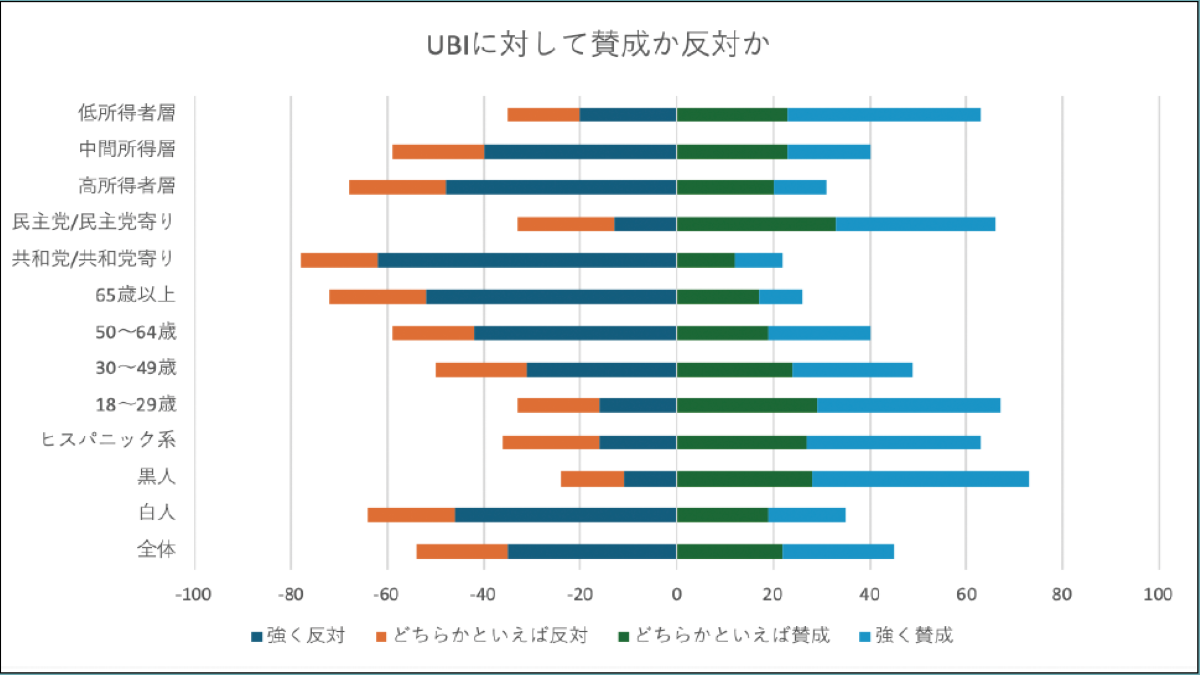
▶Regarding the introduction of BI, more people of color are in favor of it among US Democratic Party supporters. It will be important to keep an eye on how the results of this election will affect the progress of BI.
The article is for members only. Please sign up to continue reading.
MAGAZINE
Iolite Vol.20
July 2026 issueReleased on 2026/05/29
Interview Michael Shaulov, CEO & Co-Founder of Fireblocks
Marcus Infanger, SVP of RippleX
PHOTO & INTERVIEW Ryoko Yonekura
Special Features
"The Future of Payments: Beyond the Gateway"
"Innovation Without Taboos: The Dual-Use Shockwave"
"The Future of Humanity Expanded by BMI: The 'Sixth Sense' Stemming from Brain-Computer Interface Devices"
[Dialogue Series] The NISHI Talk: Crypto Conversations"The 'True Decentralization' of DeFi and the Challenges Facing the Crypto Industry"
Kasou NISHI × Yoshihiko Uchida
Series Tech and Future by Toshinao Sasaki... and more.
MAGAZINE
Iolite Vol.20
July 2026 issueReleased on 2026/05/29
Interview Michael Shaulov, CEO & Co-Founder of Fireblocks
Marcus Infanger, SVP of RippleX
PHOTO & INTERVIEW Ryoko Yonekura
Special Features
"The Future of Payments: Beyond the Gateway"
"Innovation Without Taboos: The Dual-Use Shockwave"
"The Future of Humanity Expanded by BMI: The 'Sixth Sense' Stemming from Brain-Computer Interface Devices"
[Dialogue Series] The NISHI Talk: Crypto Conversations"The 'True Decentralization' of DeFi and the Challenges Facing the Crypto Industry"
Kasou NISHI × Yoshihiko Uchida
Series Tech and Future by Toshinao Sasaki... and more.