


RWA tokens facilitate the on-chain representation of real-world assets such as real estate, government bonds, private credit, commodities, and art, enabling fractional investment, 24/7 trading, and automated rights transfer. Previously accessible only to large investors, these high-value assets are now more accessible, reducing intermediary costs and settlement times, thus involving a broader investor base in this new financial layer.
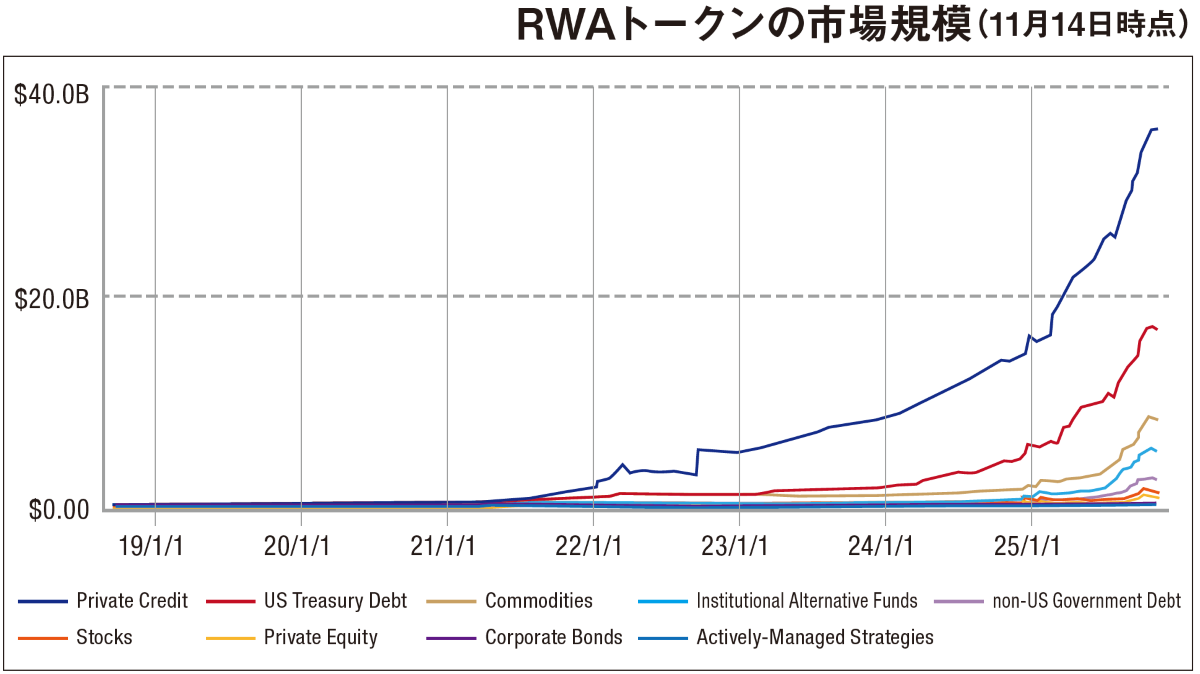
From 2022 to June 2025, the RWA token market is expected to grow by approximately 380%, reaching about $35.7 billion by November 2025. Private credit tokens, already worth around $17 billion, are the largest segment, followed by government and short-term bonds, and real estate tokens. With major institutions like BlackRock and Franklin Templeton entering the market, a scenario is emerging where, by 2030, the market could grow to $16 trillion and by 2035 to several tens of trillions, making on-chain government bonds, corporate bonds, and real estate the "new normal" in finance.
In Japan, against the backdrop of the Financial Services Agency's organization of digital securities and STs, the issuance balance of real estate STs has reached approximately 270 billion yen, with companies like Progmat and SBI Group advancing the practical use of RWA and STs. Meanwhile, government funds in the Middle East and GCC are increasing their investments in Japan's real estate, infrastructure, and decarbonization sectors, tightening capital collaboration between the regions. As cooperation in energy, infrastructure, and the digital economy progresses, compliant RWA tokens are becoming the "standard infrastructure" for cross-border investments, positioning Japan as a reliable Web3.0 financial hub.
Tokenization of real-world assets involves transferring the value of tangible assets onto digital platforms, making it tradable on the blockchain. This includes a wide range of real assets from real estate and debt securities to precious metals, and even art and wine. Traditionally, these assets were difficult to divide ownership and liquidate, requiring extensive procedures and time. Therefore, RWA tokenization is seen as a groundbreaking technology that fundamentally changes these inefficiencies.
Its main feature is the ability to fractionalize value, allowing more investors to participate in assets previously accessible only to large investors. The transparency provided by recording rights transfers on the blockchain also significantly reduces intermediary costs and settlement times, which were unavoidable in traditional financial transactions. For financial institutions, it also facilitates the liquidity of held assets and the design of new investment products, offering substantial benefits.
Given this backdrop, the RWA token market is expected to expand rapidly after 2024. In the US, Europe, and the Middle East, the tokenization of government bonds, securities, repo transactions, and real estate is advancing quickly, with major financial institutions accelerating their involvement. In Asia, Japan, Singapore, and Hong Kong are advancing regulatory frameworks, increasingly prioritizing RWA tokenization. Going forward, RWA tokens are likely to play a significant role in the financial infrastructure of various countries.
RWA tokenization is not just a digital technology initiative but a new concept that reconstructs the core of the economy: asset ownership, transfer, and circulation. The arrival of a new era in finance is imminent.
In recent years, the RWA tokenization market has expanded rapidly, growing from a few billion dollars in 2022 to approximately $30 billion by 2025. According to a report by RedStone Finance, the RWA token market grew by about 380% over the three years from 2022 to June 2025.
This indicates a shift in perception of RWA tokenization from experimental to a fully-fledged financial product. The rapid growth is underpinned by institutional investor participation, regulatory framework development, and the introduction of traditional assets like debt on the blockchain.
Private credit markets, in particular, have shown significant presence. InvestaX's third-quarter report on RWA tokens indicates that about $17 billion of private credit was tokenized by 2025, making up a large portion of the RWA token market. Traditionally, private credit was a market with low liquidity and difficult for average investors to access. However, tokenization has allowed for segmentation, making it easier for yield-seeking capital to enter, thus rapidly expanding the market.
Following in size are government and short-term bonds. Particularly, about $7.3 billion worth of U.S. bonds were tokenized by 2025. These are among the most liquid assets globally, and benefit from blockchain features like 'instant settlement' and '24-hour trading'. Major financial institutions such as BlackRock and Franklin Templeton have also entered the market, suggesting potential for further growth.
Asset classes such as real estate and commodities are also expanding. The real estate market alone is a massive $340 trillion market globally. Even a partial tokenization of this market could have an immense impact.
According to a report by Emergen Research, real estate-related RWA tokens accounted for about 34% of the total in 2024. However, due to issues with rights and ownership transfers, the growth rate is somewhat slower than that of credit assets.
The RWA token market is currently entering an expansion phase. With the full-scale entry of institutional investors, further market expansion is expected, and a wide variety of assets will be deployed on-chain.
Additionally, the demand for RWA tokens of trending items like trading cards and wines or whiskies is increasing, with real-world examples already emerging. Given these developments, active trading of RWA tokens by individual investors is anticipated to increase.
In Japan, the movement surrounding RWA tokens is accelerating. Since 2023, the Financial Services Agency has clarified regulations concerning the handling and accounting of digital securities, followed by a significant increase in the issuance of real estate STs (Security Tokens).
It is important to note that while STs and RWA tokens share similar attributes, they are not necessarily the same. STs refer to the digitalization of securities such as stocks and corporate bonds using blockchain technology, whereas RWA tokens do not always involve the tokenization of securities. However, the nature of RWA tokens might subject them to different legal considerations.
Domestically, the demand for real estate STs, utilizing the digital asset platform 'Progmat' funded by major banks, is on the rise. According to market summary data provided by Boostry, as of the time of writing, the total issuance of STs in Japan is approximately 270 billion yen, with real estate STs accounting for the majority.
Furthermore, movements by SBI Holdings are also becoming more active. In August 2025, they plan to establish a joint venture company related to RWA tokens with Startale Group. Additionally, major financial institutions led by SBI Holdings are considering 24-hour trading of equity tokens. Given these trends, the trading of RWA tokens and STs in Japan is expected to become more active in the future.
As of November 2025, the RWA token market has reached approximately $35.7 billion, with government bonds, private credit, and real estate driving demand and accelerating transactions. Major financial institutions are entering the market and regulatory frameworks are being established globally, marking the year when real-world assets began to be digitized and integrated into financial infrastructure.

According to Standard Chartered Bank, the RWA token market is expected to expand rapidly, reaching approximately $2 trillion by 2028. Following government bonds, private credit, and real estate, the on-chain transformation of major assets such as money market funds and publicly traded stocks is expected to fully materialize. Additionally, with the increasing circulation of stablecoins, RWA tokens are beginning to form a "new financial layer" directly connected to seamless on-chain payments.
By 2030, the positioning of RWA tokenization will shift from the "periphery" to the "core" of financial markets. Although there is variation among companies, a joint analysis by Boston Consulting Group and ADDX predicts that the market size for RWA tokens will reach $16 trillion by 2030. Considering that the total market capitalization of the cryptocurrency market at the time of writing is about $3.3 trillion, this represents a growth to approximately five times that size.
By this time, the on-chain transformation of government bonds, corporate bonds, and real estate will have accelerated further, and financial institutions will increasingly incorporate tokenized assets into their portfolios.

By 2035, RWA tokens are expected to become "mainstream financial infrastructure." A diverse range of assets, including infrastructure, real estate, and corporate debt, will be tradable on-chain 24/7, with asset value transfers and their backing synchronized on-chain, fundamentally changing the financial infrastructure. Various reports predict a market size of around $10 trillion by 2030, with growth expected to reach tens of trillions of dollars by 2035. Once regulations, technology, and international collaborations are fully established, the issuance, operation, and circulation of assets will become 'the norm' on the digital layer.

The expansion of the RWA token market is being propelled by the full-scale entry of global institutional investors. As the on-chain processing of government bonds, private credit, and real estate transactions progresses, asset management firms and banks have begun to treat RWA tokens on par with traditional financial products. Private credit, in particular, is expected to yield high returns, and the transparency and liquidity provided by tokenization are encouraging capital inflows.
BlackRock, one of the world's largest asset managers, is a symbolic figure in this movement. The company has begun offering tokenized funds and is setting up systems to manage short-term bonds and money market funds on-chain. Furthermore, BlackRock has publicly announced plans to integrate RWA tokens with stablecoins and digital payment infrastructures, significantly influencing the standardization across the industry. Other major asset managers like Franklin Templeton and WisdomTree are also expanding their RWA token-related funds, creating an environment where institutional investors can access the 24-hour on-chain market.
Meanwhile, the movements of government funds in Middle Eastern GCC countries are also noteworthy. In the UAE and Saudi Arabia, there is a strong focus on tokenizing infrastructure and energy-related assets, with a significant portion of their massive operational funds potentially moving to the on-chain market. This accelerates the use of RWA tokens as a means to streamline cross-border investments and expand investment targets.
Recently, capital collaboration between Japan and GCC countries has been strengthening, particularly in the energy and infrastructure sectors. Government funds from the UAE and Saudi Arabia, in particular, are increasing their investments in Japanese real estate and renewable energy projects, leading to tighter financial integration between the two regions. This trend could extend into the digital asset domain, potentially leading to joint investment projects using RWA tokens and digital securities. As digitalization of cross-border investments progresses, the capital linkage between these regions could accelerate even further.
Considering these global trends, RWA tokens are likely to evolve beyond the confines of traditional finance, becoming a 'new financial infrastructure' that institutional investors use routinely.

Japan and the GCC countries have long established their relationship centered around the supply of oil and natural gas, but recently there has been a shift towards cooperation in the decarbonization sector. Particularly in areas such as hydrogen, ammonia, renewable energy, and CCS (Carbon Capture and Storage), where GCC countries are promoting a 'post-oil economy' as a national strategy, joint ventures and investment discussions with Japanese companies are accelerating.
For Japan, the aim is to enhance energy security and expand clean energy technologies internationally, with both parties' interests aligning. This deepening cooperation is also spreading to infrastructure investments and industrial sectors, forming a broad foundation for capital collaboration.
In the GCC countries, major government funds such as Saudi Arabia's PIF (Public Investment Fund), UAE's Mubadala, and ADQ are actively pursuing investments in Japan. These investments span a wide range of sectors including real estate, infrastructure, logistics, advanced technology, and life sciences, characterized by strategic investments with a long-term view of industrial development.
These funds have massive operational scales and make swift investment decisions, offering new collaboration opportunities for Japanese companies. There are also movements to position the Japanese market as an Asian hub, making capital flows between the two regions more active and clear than before.
The GCC countries are advancing the strengthening of their digital economies at the national level, with investments in blockchain, fintech, and tokenized assets growing rapidly. In Japan, the Financial Services Agency is advancing the regulatory framework for ST and RWA tokens, and the potential for digital cross-border investments and joint funds is expanding.
Furthermore, as GCC continues to develop 'digital public infrastructure' as a pillar of economic diversification, the areas in which Japanese companies can participate are also expanding. While specific projects are still in the early stages, the potential for mutual financial infrastructure connectivity and capital flows through tokenized assets is being demonstrated, with expectations for expanded collaboration in the future.
◉ Fawzi Hamze
Founder/CEO of Assets Advisors Capital Co., Ltd.
With over 15 years of involvement in the UAE's business ecosystem, Fawzi Hamze has built a solid reputation in private banking and luxury real estate. At Qatar National Bank, he managed assets worth over $1 billion for more than 100 high-net-worth clients and built a strong relationship with the Qatar Investment Authority.
Leveraging his experience in Dubai's luxury real estate market, he handles transactions of high-end properties. Currently based in Tokyo, he plays a pivotal role in bridging investment flows between the Gulf countries and Japan.

