
Traditionally, money has been a mechanism to omit transaction details and accelerate consensus. However, blockchain enables the acceleration of value transfer while maintaining accurate ledgers at low cost, marking 2026 as the turning point for the 'rebirth of money'.
The three types, differing in issuer and design philosophy, are suited for different roles: domestic infrastructure (CBDCs), safety and corporate use (deposit tokens), and cross-border flexibility and Web3.0 compatibility (stablecoins). As regulatory frameworks evolve, they will coexist as 'optimal solutions' tailored to specific purposes.
Staking, lending, DeFi, and RWA represent new ways to earn by participating in protocols without traditional employment or financial institutions. Further advancements in AI wallets and AI labor could automate management and contracts, potentially shifting the focus from monetary-centric measures to personal values like narratives, emotions, and trust (e.g., meme coins and 'multiple values per item').
Money, which has dominated societies for about 6,000 years as a means of value transfer, owes its greatest invention to its ability to be transferred anonymously, unlike securities. Originally, transaction ledgers needed to be detailed.
However, the transformation of these detailed records into a system that captures sales through mere currency counts has made money universally usable and expanded transaction volumes. Yet, with the advent of blockchain, it is now possible to maintain accurate transaction ledgers without incurring high costs. Perhaps it is time for money, born out of compromise, to change its form.
Have you ever considered the essence of a sales contract, which involves transferring value from A to B? When A transfers goods to B, and B pays money to A, the contract is established.
Why must money be exchanged in a contract? Because money serves as a measure of value, based on a 'somewhat social consensus'. A product valued at 10,000 yen by A might be worth 12,000 yen to B. However, involving money allows for a quick consensus without the need for prolonged negotiation over price.
As evident, money does not accurately measure the true value of items in the world. A job paying 1,500 yen per hour values diligent and slack workers equally. Similarly, 10,000 yen earned rightfully and 10,000 yen stolen are both accepted as 10,000 yen in stores. Money has excelled as a tool that speeds up transactions by omitting the process of consensus formation.
However, blockchain and smart contracts aim to record even the information that money has traditionally omitted, achieving faster value transfers. This is a method humanity has never experienced before. What kind of future will emerge from this? In 2026, money entered a phase of 'rebirth'.
Japan's Cashless Payment Ratio
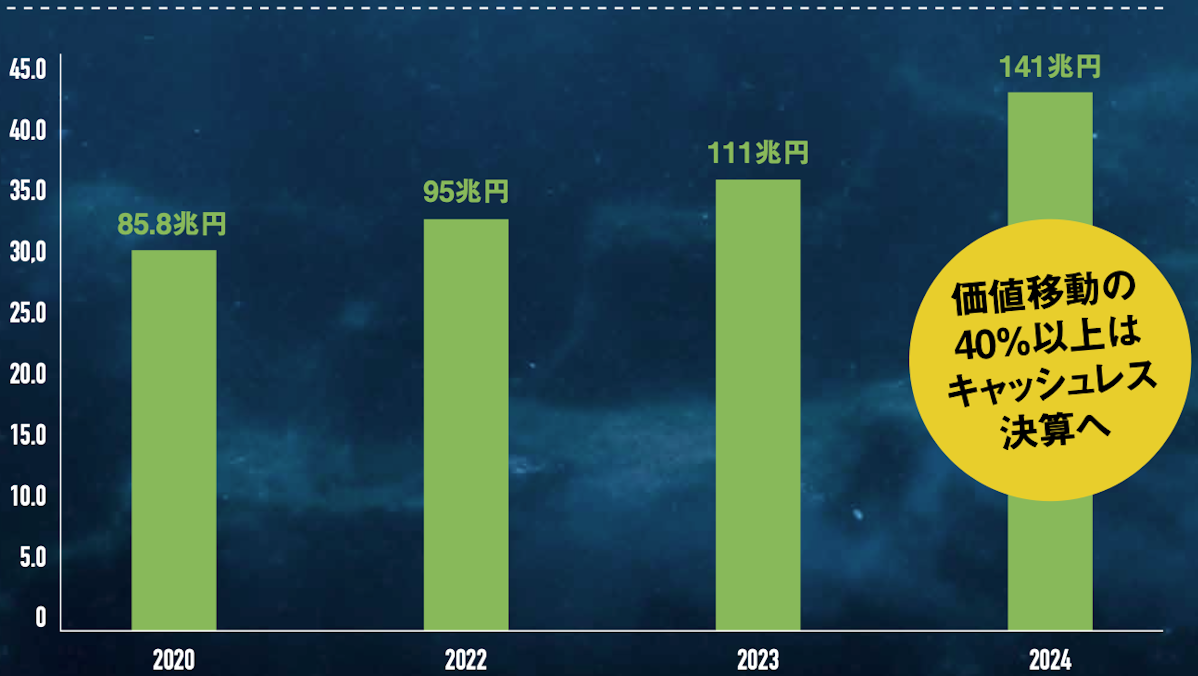
The Ministry of Economy, Trade and Industry aimed to increase Japan's cashless payment ratio to 40% by 2025. Already, more than 40% of transactions have shifted to cashless.
Number of 1-Yen Coins Minted in Japan
Source: Japan Mint
The number of 1-yen coins minted peaked at 2.8 billion in 1990 and has continued to decline, now only about 1 million coins (worth 1 million yen) are produced. The demand for physical currency is decreasing.


