


Instead of developing entirely new autonomous vehicles, this approach aims to implement practical and affordable self-driving capabilities by retrofitting existing vehicles with the necessary systems. This lowers the barrier to adoption and expands the potential for real-world deployment and monetization, particularly for municipalities.
By leveraging satellite data and mapping information, the system is designed to operate without relying on real-time AI-based decision-making. While it is not suited for high-speed driving, it enables stable, low-cost operation, making it a highly practical solution for providing mobility to transportation-disadvantaged populations.
The essence of this initiative lies not in autonomous driving technology itself, but in addressing real-world issues such as transportation shortages in rural areas and mobility challenges faced by the elderly. By prioritizing practical solutions in collaboration with local communities, it presents a sustainable model for future mobility.
Autonomous vehicles, considered the future of automobiles, are categorized into levels 1 to 5 in Japan, depending on their degree of autonomy. Currently, the autonomous vehicles sold in the country are at level 2, which allows for hands-free driving on highways but is far from full automation.
The autonomous vehicle 'KITT' from the sci-fi drama 'Knight Rider' was a supercar that could think and drive itself. Originally installed in a supercomputer, the AI known as 'K.I.T.T.' was later transferred to 'Knight 2000', powering the supercar. For those who already own a car, the idea of retrofitting their vehicle with an autonomous driving system like 'Knight 2000' is appealing.
'Our company has been around for 78 years. Initially, we dealt with bus radios and later became a major distributor of car audio and navigation systems,' said Genta Abe, CEO of Tokai Clarion Co., Ltd. The company has developed a retrofit autonomous driving system. The shift in business focus was prompted by changes in the business environment.
'The decline in car interest among young people and the proliferation of smartphones have drastically reduced the demand for car navigation systems. Then came the 2011 earthquake. I had just become president at that time, and I realized that just watching the industry shrink was not an option, so we shifted to designing our products and manufacturing them overseas. We also designed accident prevention detection cameras for trucks,' Abe explained.
One day, confident in their development, they received a request from a Thai university startup to borrow a dashcam. This startup had an idea to monitor road conditions from satellites and use this data for autonomous driving technology. Abe found the idea intriguing and agreed to a partnership, applying for a government demonstration experiment. The most significant feature of their autonomous driving technology was its ability to be retrofitted.
'We made a big announcement in June 2022. Thinking about how to promote it, we decided to target local governments where public transportation is declining, saying, "We are creating low-cost autonomous driving," and exhibited at a trade show. This led to several inquiries, and from 2023, we started running tests in towns,' Abe said.
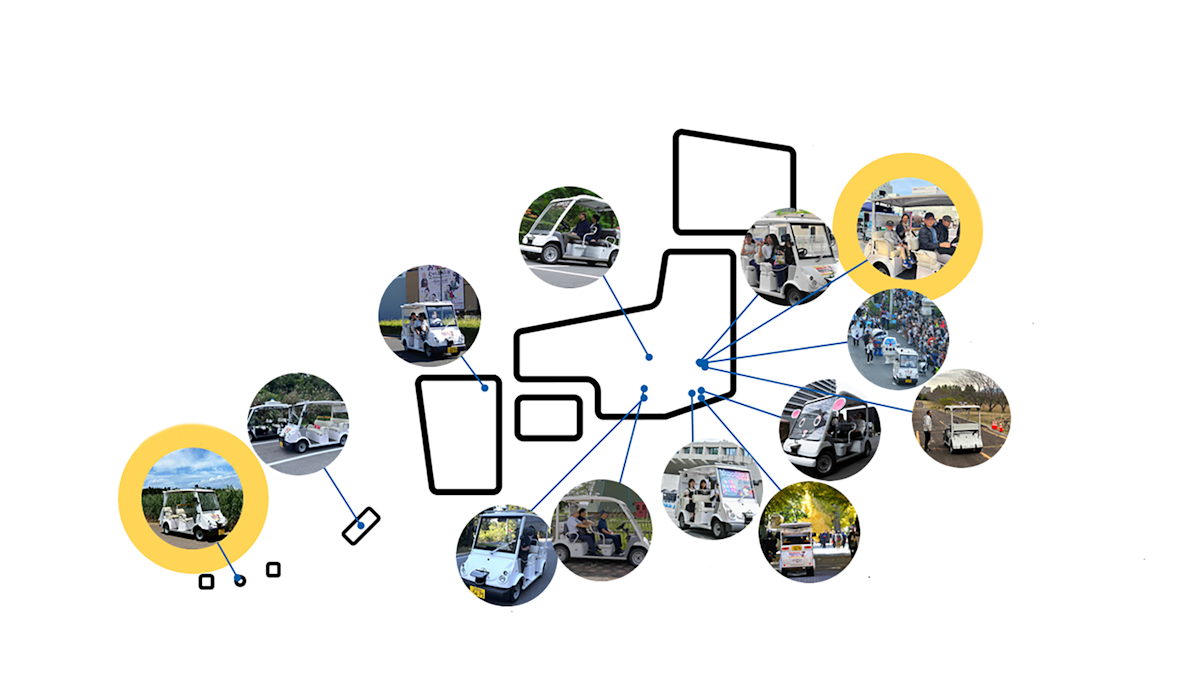
Currently, demonstration experiments are being conducted in 13 locations nationwide, from Ibaraki in the north to Okinawa in the south. The vehicles used in these experiments are based on golf carts, with systems retrofitted to them. They are used at event venues, tourist spots, and islands with low traffic, collecting data on their ability to operate without issues and assist those with mobility challenges.

