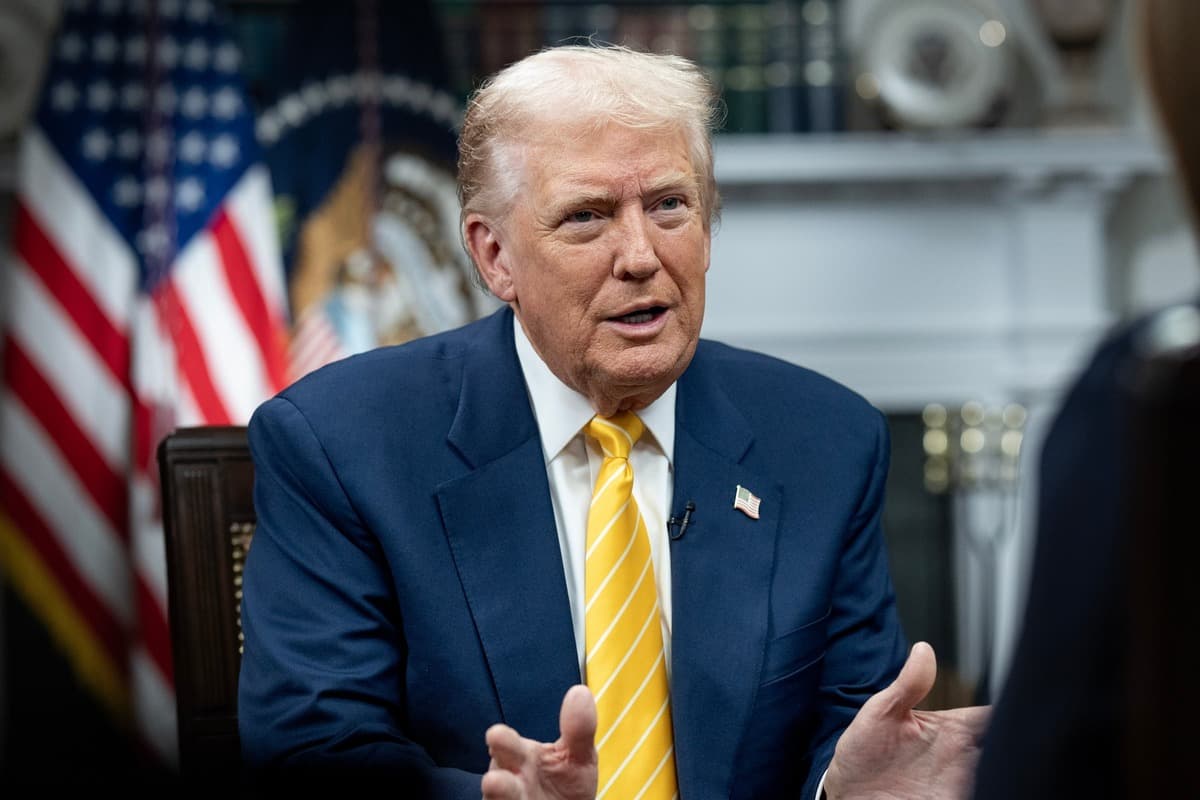
President Donald Trump said on Oct. 21, U.S. time, that he would require new large-scale data centers to generate the electricity they use, in a post on Truth Social. He called for surplus power to be supplied or sold to local communities and the grid, and urged companies to pay “dividends” to host communities and residents.
“New and large, in some cases gigantic, Data Centers are mandated by me to make their own electricity, and give or sell any excess back to the local community, or grid,” Trump wrote. “If companies want to make their Data Centers popular, pay the community, and/or individuals within the community, a ‘dividend.’”
The post did not say when the requirement would take effect, how large a facility would have to be to fall under it, or which agency would oversee it. As of Oct. 22, Japan time, neither the White House nor the Department of Energy (DOE) had issued an executive order or other legal measure, or provided further details. The size of the dividends and how they would be funded have also not been disclosed.
In a presidential proclamation in March 2026, the administration launched the Ratepayer Protection Pledge, which called on hyperscalers (large cloud providers) and AI companies to build their own generation capacity or procure the power they need, and to cover the cost of grid upgrades. According to the White House, more than 200 utilities, data center developers, states and others joined when the pledge was expanded in July. However, negotiations over rate structures are voluntary, and the pledge is not legally binding.
BlackRock Chairman and CEO Larry Fink said in an interview with Bloomberg TV the same day: “If we don’t build out these data centers, it is actually more inflationary because the cost of compute is so high right now.”
Electricity prices in the U.S. continue to rise. According to the Short-Term Energy Outlook from the U.S. Energy Information Administration (EIA), residential electricity prices are expected to climb about 10%, from 16.5 cents per kilowatt-hour in 2024 to 18.2 cents in 2026. In a December 2024 report, Lawrence Berkeley National Laboratory estimated that data center electricity consumption will grow from 176 terawatt-hours (TWh) in 2023 to between 325 and 580 TWh by 2028.
In a Gallup survey conducted in March and released in May, 71% of respondents said they opposed the construction of an AI data center in their area. In his post, Trump also noted that data centers “that were highly unpopular in a certain area, have become extremely popular when a financial deal is struck.”
On the question of “dividends” for residents, the Bitcoin Policy Institute (BPI), a bitcoin policy research organization, released specific estimates on Sept. 9. It calculated that a rural county hosting a 1-gigawatt data center could distribute $4,500 to $8,900 per household per year from surplus property tax revenue. It is unclear whether there is any connection between BPI’s proposal and Trump’s post.
Bitcoin miners have also been pursuing an approach close to what the post calls for: generating their own power and selling the surplus to the grid. MARA, a major U.S. miner, owns a wind farm in Texas that supplies power directly to its own data center without going through the grid. In April 2026, the company announced an agreement to acquire Long Ridge Energy & Power, which owns a 505-megawatt gas-fired power plant in Ohio, for about $1.5 billion. The deal is expected to close in the second half of 2026, and MARA has said it will not reduce the plant’s supply to the grid after the acquisition.
Miners are also using their existing grid connections to expand into AI-related businesses. According to a tally by Supercomputing News based on companies’ filings with the U.S. Securities and Exchange Commission (SEC), eight miners have contracted about 5.7 gigawatts of capacity for AI use, of which 872 megawatts, or roughly 15%, is currently operational.
However, the post did not say whether cryptocurrency mining facilities would fall under the requirement. Preliminary EIA estimates put U.S. cryptocurrency mining at 0.6% to 2.3% of the country’s electricity consumption. American Bitcoin, where Trump’s second son, Eric Trump, serves as co-founder and chief strategy officer, held about 89,242 mining machines as of the April-June quarter of 2026.
Separately, the House of Representatives passed the Ratepayer Protection Act, a bill aimed at protecting ratepayers, by a vote of 417-3 in September. In a Sept. 30 Senate vote, however, the bill drew only 57 votes in favor, short of the 60 needed to end debate and move to a final vote.
Image:ShutterStock
The Invisible Credit Behind the AI Market—Who Funded the Purchase of GPUs?