※This article is intended for informational purposes and does not constitute a recommendation to buy or sell any specific cryptocurrency.
Recently, in the cryptocurrency market, there is a growing trend of nations and corporations holding Bitcoin (BTC) and integrating it into their systems. In the United States, institutional investment through spot ETFs (Exchange-Traded Funds) continues to flow, and in Japan, the revised Financial Instruments and Exchange Act was enacted in July 2026.
Meanwhile, BTC's price has been significantly declining since its all-time high in October 2025. This article organizes the roadmap from Bitcoin's decentralized development structure, BTC's mechanisms, price trends, regulatory developments in Japan and the U.S., to quantum computing countermeasures, and explains BTC's future prospects and risks.
Bitcoin, launched in 2009, is the world's first cryptocurrency. It accounts for about 60% of the total cryptocurrency market capitalization and is often referred to as "digital gold" due to its capped supply.
Following the approval of spot ETFs in the U.S. in 2024, holdings by institutional investors and publicly traded companies surged, reaching an all-time high of $126,000 in October 2025. The U.S. government has also announced plans to hold seized BTC as a "strategic reserve asset."
However, since 2026, the price has significantly dropped, remaining well below its peak. In Japan, regulatory frameworks are being developed for a 20% capital gains tax and ETF approval, altering the landscape for individual investors.

Bitcoin has no issuing company or foundation responsible for its operation. The software is developed by developers worldwide through open-source collaboration, and any rule changes require broad consensus among stakeholders.
Bitcoin was born from a paper published in October 2008 by an unknown individual or group under the pseudonym "Satoshi Nakamoto." The first block, known as the genesis block, was mined in January 2009, marking the start of the network's operation.
The vision was to create a "P2P electronic cash system" that enables direct transactions between individuals without intermediaries like banks. Satoshi Nakamoto stepped away from development around 2010, and their identity remains unknown. It is believed they hold over 1 million BTC mined in the early days, though these coins have largely remained untouched.
As of October 2026, the main entities involved in Bitcoin's development and operation are as follows.
Entity | Role |
Bitcoin Core Developers | Develop the widely used node software "Bitcoin Core." A few "maintainers" are responsible for incorporating changes. |
Alternative Software Developers | Develop node software other than Bitcoin Core, such as "Bitcoin Knots." |
Development Support Organizations | Organizations like Brink, OpenSats, and Chaincode Labs support developers through donations and grants. |
Node Operators and Miners | Influence final decision-making by choosing which software to use and which specification changes to accept. |
The absence of a central authority is a key reason Bitcoin is trusted as a "neutral asset" that cannot be altered by government or corporate interests. The 21 million BTC issuance cap has been maintained for over 15 years due to this structure.
However, disagreements can lead to prolonged conflicts. In 2025, a debate arose over Bitcoin Core's relaxation of limits on embedding data in transactions.
Dissenting node operators switched to the alternative software "Bitcoin Knots," and by September 2025, Knots reportedly accounted for about a quarter of public nodes. As of October 2026, this figure stands at approximately 17%. While the network has not split, the incident highlighted the challenges of consensus building.
The entities holding Bitcoin have expanded from individual investors to corporations and nations. The main large holders are as follows.
Holder | Holdings | As of |
Satoshi Nakamoto (estimated) | Approx. 1.1 million BTC | Mined between 2009 and 2010 |
U.S. Strategy | Approx. 850,000 BTC | October 2026 |
U.S. BlackRock's IBIT | Approx. 800,000 BTC | October 2026 |
U.S. Government | Approx. 328,000 BTC | Estimated as of December 2025 |
U.S. SpaceX | 18,712 BTC | End of June 2026 |
SpaceX, which went public in June 2026, disclosed its holding of 18,712 BTC in its pre-IPO filing and confirmed maintaining the same amount in its first quarterly report post-IPO as of the end of June. While some sales have occurred, the trend of companies holding BTC as a financial asset is becoming established.
Changes to Bitcoin's specifications are discussed based on proposals called "BIPs" (Bitcoin Improvement Proposals). Anyone can submit a BIP, but registration in the BIP repository does not guarantee adoption.
Implementing a "soft fork" to change network rules requires consensus among a wide range of stakeholders, including developers, node operators, miners, exchanges, and users. Since no single entity makes decisions, significant changes typically take years to realize.

BTC is a cryptocurrency used within the Bitcoin network. Transactions are validated through a mechanism called PoW (Proof of Work), where miners perform extensive calculations in exchange for newly issued BTC.
The most notable feature is the fixed issuance cap of 21 million BTC. Unlike fiat currencies that central banks can increase, the supply is predetermined, earning it the moniker "digital gold."
• Issuance Cap: Fixed at 21 million BTC. The issued amount surpassed 20 million BTC in March 2026, with the remaining approximately 1 million BTC to be issued by around 2140.
• Halving: Mining rewards are halved approximately every four years. The most recent halving occurred in April 2024, reducing the reward per block to 3.125 BTC. The next is expected around 2028.
• Lost Coins: It is estimated that millions of BTC are permanently inaccessible due to lost private keys, further reducing the actual circulating supply.
• High Security: The network is protected by the world's largest computational power (hash rate), making tampering virtually impossible.
The Bitcoin block generation interval is approximately 10 minutes, with the capacity to process only a few transactions per second. Network congestion can lead to soaring fees and delayed confirmations.
The "Lightning Network," built on top of Bitcoin, addresses these issues. It processes transactions off-chain, recording only the final result, enabling near-instant and extremely low-fee microtransactions.
Compared to Ethereum (ETH) and XRP, which rank high by market capitalization, Bitcoin prioritizes robustness over multifunctionality.
Item | Bitcoin (BTC) | Ethereum (ETH) | XRP |
Year of Release | 2009 | 2015 | 2012 |
Issuance Cap | 21 million BTC | No cap | 100 billion XRP (fully issued) |
Consensus Mechanism | PoW | PoS (Proof of Stake) | Unique consensus mechanism |
Governing Body | None | Ethereum Foundation supports development | Ripple is deeply involved |
Main Role | Store of value | Smart contract platform | International remittances |
Initially conceived as "electronic cash," Bitcoin is now primarily used for the following purposes:
1. Store of Value: Held long-term as a hedge against inflation and currency devaluation, similar to gold.
2. Investment Target for Institutional Investors: Pension funds and asset management companies invest through U.S. spot ETFs from their securities accounts.
3. Corporate and National Reserve Asset: Publicly traded companies hold it as a financial asset, and the U.S. retains seized BTC as a strategic reserve asset.
4. International Remittances and Payments: Used as a remittance method for people without bank accounts or in countries with capital controls.
BTC is a widely handled asset by most registered cryptocurrency exchanges in Japan, with many offering purchases in small amounts with Japanese yen.
Current Price: Approximately $80,900 (as of October 15, 2026, CoinMarketCap)
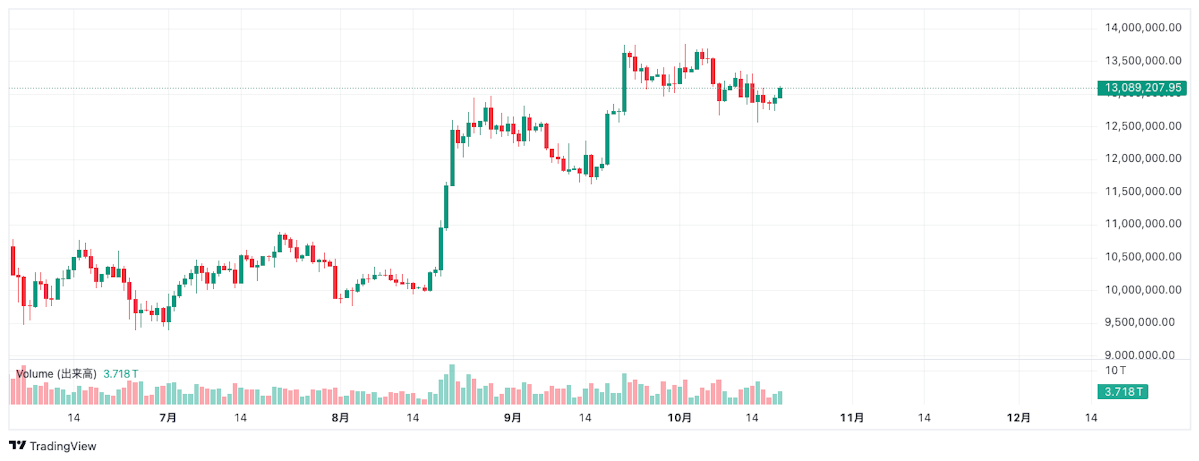
BTC price trends (in USD, August 2025 to October 2026). Prices at major reported points, not continuous daily data, with approximate dates for lows in January and February.
BTC reached an all-time high of $126,198 on October 6, 2025 (CoinMarketCap). However, on October 10, a sudden drop occurred as approximately $19 billion in leveraged trades were forcibly liquidated, leading to a downward trend.
By February 2026, it briefly fell below $60,000, and by mid-July, it hovered around $62,000, marking a decline of about 50% from its peak. Although it recovered after August, the price remained heavy around $80,000 due to higher-than-expected U.S. inflation indicators and selling pressure on AI-related stocks.
The factors potentially supporting BTC's price can be broadly categorized into the following five:
• Institutional Investment Inflows: The U.S. spot Bitcoin ETF has been accumulating assets since its launch in January 2024. The largest, IBIT (BlackRock), alone has reached a net asset size exceeding $60 billion.
• Corporate Holdings Expansion: Strategy holds over 840,000 BTC, equivalent to about 4% of the total issuance cap.
• Supply Scarcity: In March 2026, the circulating supply surpassed 20 million BTC, with new issuance falling below 1% annually. Each halving further reduces new selling pressure.
• U.S. Policy: The U.S. government has indicated a policy of holding rather than selling seized BTC, with legislation to increase market purchases under discussion.
• Japanese Regulatory Developments: The amended Financial Instruments and Exchange Act was enacted in July 2026, paving the way for the domestic approval of Bitcoin ETFs and the introduction of a 20% separate taxation on capital gains.
Price forecasts vary significantly among experts. Bullish predictions suggest it could exceed $175,000, while others foresee a potential drop back to around the 2026 low of $60,000. It's crucial to consider both upside and downside scenarios, as BTC remains susceptible to macroeconomic trends, including the Federal Reserve's monetary policy.

Initially, Bitcoin was viewed with suspicion by many countries due to its potential misuse for money laundering and its volatile price swings. However, in recent years, there has been a shift towards recognizing it as a legitimate financial asset within regulatory frameworks in major countries.
Unlike XRP, which faced prolonged litigation over its classification as a security, Bitcoin is considered the most established cryptocurrency in terms of regulation.
Japan is also undergoing significant institutional changes. The bill to amend parts of the Financial Instruments and Exchange Act and the Payment Services Act, submitted to the National Diet in April 2026, was passed and enacted in the House of Councillors plenary session on July 15.
The classification of cryptocurrencies will change from "means of payment" under the Payment Services Act to "financial instruments" under the Financial Instruments and Exchange Act, subjecting them to regulations like insider trading, similar to stocks. The most significant impact for individuals holding BTC will be the changes in taxation and ETFs.
• Taxation: Currently subject to a maximum of 55% comprehensive taxation, there is a plan to apply a 20% separate self-assessment taxation for certain cryptocurrency transactions. Depending on the timing of the revised law's implementation, this is expected to be applied from 2028.
• Loss Carryforward Deduction: A system allowing losses to be carried forward for three years to offset profits in subsequent years is also expected to be included.
• Bitcoin ETF: The legal amendment has paved the way for the creation and listing of ETFs. The Nikkei reported that the initial target for listing is being discussed for 2028, although the timing is not yet confirmed.
Let’s put the policy into concrete numbers.
Consider a salaried worker with an annual income of ¥6 million who realizes a ¥1 million gain selling BTC. If their taxable income after the employment income deduction and other deductions comes to roughly ¥3 million, the ¥1 million crypto gain is added on top, bringing taxable income to ¥4 million.
Under the current system, that ¥1 million is taxed at progressive rates alongside salary. The bracket for taxable income above ¥3.3 million and up to ¥6.95 million carries 20% income tax plus 10% residence tax, making the tax burden roughly ¥300,000.
Under separate self-assessment taxation from 2028 onward, crypto gains are calculated apart from salary. At a flat 20.315%, the burden falls to roughly ¥200,000 — a difference of about ¥100,000.
The gap widens as gains grow. At the same income level, a ¥10 million gain pushes taxable income into the ¥13 million bracket under the current system (33% income tax plus 10% residence tax), for a burden of roughly ¥4 million. Under separate taxation, it would be about ¥2.03 million — a difference approaching ¥2 million.
The bigger your crypto gains, the worse the current system treats you. That is why the “55% tax rate” has long deterred investors in Japan, and it is the heart of this reform.
This gap creates a practical dilemma. Anyone sitting on unrealized gains now faces a choice: realize them during 2027, or hold out until 2028.
Compare tax rates alone and waiting looks like the obvious move. Three caveats deserve attention.
First, the effective date is not yet fixed. The amended Income Tax Act was enacted on March 31, 2026, but the starting point for application is tied to the effective date of the Financial Instruments and Exchange Act (FIEA) amendments. The FIEA amendments are to take effect within one year of promulgation; if that happens during 2027, application from January 2028 is expected — though a delay remains possible.
Second, a price decline while you wait defeats the purpose. A 10-point drop in the tax rate counts for nothing if the price falls 30% in the meantime. The risk of letting tax considerations dictate trade timing is one that equity markets have highlighted time and again.
Third, not every transaction will qualify. The new regime is expected to center on transactions in “designated crypto assets” handled by registered domestic operators. If trades on overseas exchanges or through DeFi fall outside its scope, they will remain subject to comprehensive taxation as before.
Alongside the rate change, the ability to carry losses forward for three years is equally significant.
Under the current system, crypto losses cannot offset other income and cannot be carried into the following year. Suppose you lose ¥1 million in 2026 and gain ¥1 million in 2027. On a net basis you have broken even — yet the ¥1 million gain in 2027 is taxed in full.
Under the new system, that ¥1 million loss can be carried forward for up to three years and offset against future gains. In other words, a losing year becomes a tax saving down the road.
This changes what it means to cut a losing position. Where losses were previously written off and forgotten, realizing them now carries tax value in its own right.
One limit is worth noting: losses cannot be offset against stocks or FX. Using crypto losses to cancel out equity gains remains off the table under the new system. Despite the shared 20.315% rate, crypto sits in a separate bucket from equities.
In the United States, the SEC (Securities and Exchange Commission) approved a spot Bitcoin ETF in January 2024. This allows anyone to invest in Bitcoin through a securities account, leading to a significant influx of institutional investment.
On March 6, 2025, President Donald Trump signed an executive order establishing a "Strategic Bitcoin Reserve." This involves holding BTC seized in criminal and civil cases as national reserve assets instead of selling them, with the U.S. government's holdings estimated at approximately 328,000 BTC. However, this figure is believed to include about 127,000 BTC that the Department of Justice sought to confiscate in October 2025, indicating a range in estimates.
Moreover, the executive order does not allocate a budget for new purchases, requiring legislative action in Congress for market acquisitions. While a bill to authorize government BTC purchases is under discussion, it has not been enacted as of October 2026. In both Japan and the U.S., uncertainties remain regarding the specifics and timing of regulatory implementation.

One of Bitcoin's long-term challenges that is rapidly gaining attention is countering quantum computing. The current signature method is at risk of being compromised if sufficiently powerful quantum computers become a reality.
In March 2026, a research team from Google announced a study that significantly reduced the estimated computational resources needed, accelerating the debate. It is estimated that approximately 6.5 to 6.9 million BTC are held in older address formats vulnerable to quantum attacks, including those held by Satoshi Nakamoto.
• BIP-360 (P2MR): A proposal to introduce a new address format resistant to quantum attacks. It was published in the BIP repository in February 2026 (status: draft). Experimental implementations by private companies have also been released.
• BIP-361: A proposal to encourage the transfer of BTC from old address formats to the new format, with the risk of making non-transferred coins unusable in the future. Released in April 2026, it faced strong opposition for potentially freezing owners' assets.
The co-authors of BIP-360 estimate that a complete transition would take at least seven years from initiation, making it a significant topic for the coming years.
Within the development community, there is ongoing debate about whether Bitcoin should be limited to monetary uses or opened up to broader applications such as data recording. The conflict over relaxing data embedding restrictions is one example, with proposals for a soft fork to reinforce these restrictions being put forward.
The introduction of covenants, which would allow for more complex transaction conditions in Bitcoin, has been a topic of discussion for many years. Given Bitcoin's conservative culture, such changes are expected to take time to implement.
On the supply side, the next halving is anticipated around 2028. Mining rewards are expected to decrease from 3.125 BTC to 1.5625 BTC per block.

Bitcoin is the most established asset among cryptocurrencies, but it cannot be held with the same mindset as stocks or bonds. From the price movements over the past year and the market structure, four key points of caution emerge.
BTC fell by about 50% from its peak in October 2025 to early 2026. On October 10, 2025, approximately $19 billion in leveraged trades were forcibly liquidated in just one day, causing a sharp price drop. It's important to be aware that trading with margin can lead to losses far exceeding the principal in the event of sudden market changes.
As institutional investors have entered the market, BTC's price movements have become more correlated with stock markets and interest rate trends. In October 2026, heightened expectations for rate hikes due to rising U.S. inflation indicators led to a decline alongside tech stocks. If you expect BTC to act as a diversifying asset with movements different from stocks, this factor needs to be considered.
A large amount of BTC is concentrated in ETFs and certain corporations. It is noted that over 80% of U.S. Bitcoin ETF assets are stored with Coinbase, which means any issues with specific entities could have significant impacts.
Additionally, companies like Strategy, which have increased their BTC holdings through borrowing or stock issuance, may face pressure to sell for liquidity, potentially exerting significant selling pressure on the market.
Countermeasures against quantum computing are just beginning, and the transition will take a long time. If you manage BTC yourself, there is a risk of losing assets due to lost private keys or fraud. Even when storing with exchanges, consider the risks of hacking or the collapse of the service provider.
While BTC is relatively stable among cryptocurrencies, it is an asset that can lose half its value in a few months. It is advisable to separate it from living expenses and determine the holding amount from a long-term perspective.

Bitcoin is the world's first cryptocurrency with no specific administrator and a fixed issuance cap of 21 million BTC. Over more than 15 years, these rules have been upheld, establishing its position as a store of value akin to "digital gold."
Following the approval of a spot ETF in the United States in 2024, ownership by institutional investors, corporations, and nations has expanded, leading to a new all-time high in October 2025. In Japan, the revised Financial Instruments and Exchange Act has been enacted, paving the way for ETF approval and a 20% capital gains tax. However, in 2026, prices fell significantly from their peak, and long-term technical challenges such as quantum computing countermeasures and development strategies remain.
While institutionalization is steadily progressing, the risk of price volatility remains significant. It is crucial to consider your approach in light of the tax and ETF developments and your risk tolerance.

As of October 2026, there are no Bitcoin ETFs listed on domestic exchanges. It is anticipated that they will be formed and listed following the implementation of revised laws, with discussions suggesting a listing timeline around 2028.
The new system is expected to apply to sales made to registered dealers from January of the year following the enactment of the revised Financial Instruments and Exchange Act. The basis is when and where you sell, not when you bought. Until then, capital gains will continue to be taxed as miscellaneous income under comprehensive taxation. The treatment of transactions with overseas dealers or between individuals will need to be confirmed by future legislation.
The next halving event is expected around 2028, reducing mining rewards from 3.125 BTC to 1.5625 BTC per block. Historically, prices have often risen post-halving, but with external factors like ETFs and interest rates becoming more influential, there is no guarantee the same pattern will repeat.
Each option has its pros and cons. Domestic registered dealers are required to segregate customer assets, but risks of hacking or bankruptcy are not zero. Managing your own wallet avoids third-party bankruptcy risks, but losing your private key means your assets are irretrievable. Choose based on your holdings and knowledge level.
Bitcoin and Domestic Stocks Lead as Top Assets: First Half of 2025 Profit Realization