
※This article is intended for informational purposes only and does not constitute a recommendation to buy or sell any specific cryptocurrency.
Ethereum (ETH) is the second-largest cryptocurrency by market capitalization, following Bitcoin. It is not merely a means of transferring funds but serves as a blockchain capable of running programs known as "smart contracts." This makes it a foundational element of Web3.0, supporting decentralized finance (DeFi), stablecoins, NFTs, and the tokenization of stocks and bonds.
In August 2025, Ethereum reached an all-time high of approximately $4,950. In the United States, spot ETFs and publicly traded companies holding large amounts of ETH (treasury companies) have emerged. A major upgrade, "Glamsterdam," which will significantly enhance the network's processing capacity, is scheduled for 2026.
However, since the beginning of 2026, the price has significantly declined, hovering around $2,400 as of mid-October, more than 50% below its peak. This article provides an in-depth analysis of Ethereum's development structure, the characteristics and future potential of ETH, regulatory trends, and future outlook.

Ethereum was developed based on a concept introduced in 2013 by Vitalik Buterin, who was 19 at the time, and the network went live in July 2015. Unlike Bitcoin, which primarily facilitates value transfer, Ethereum aimed to be a 'world computer' capable of running arbitrary programs on the blockchain, marking a groundbreaking advancement.
The development is supported by the Ethereum Foundation, a non-profit organization based in Switzerland. The foundation is committed to creating an environment where programs operate 'as designed, without the possibility of downtime, censorship, fraud, or third-party interference.'
While the Ethereum Foundation plays a central role in supporting development, it does not manage or control the network. Ethereum's development is divided among many independent organizations as follows:
Entity | Role |
Ethereum Foundation | Support for research and development, grant provision, upgrade coordination |
Client Development Teams | Multiple independent teams developing node software such as Geth, Nethermind, Prysm, Lighthouse |
All Core Devs Meetings | Key developers regularly gather to publicly discuss upgrade content and schedules |
Layer 2 Development Companies | Independent networks like Arbitrum, Optimism, Base (Coinbase) that handle processing on top of Ethereum |
Since multiple teams independently develop node software, the network is less likely to halt due to a single software issue. This 'client diversity' is a crucial feature supporting Ethereum's security.
Ethereum serves as a primary foundation for traditional financial institutions utilizing blockchain technology.
Ethereum has established a decentralized development structure that does not rely on specific companies, and since its launch in 2015, the network has never stopped. This reliability is one reason it is favored by institutional investors.
However, the Ethereum Foundation's operations have faced criticism. The foundation's sale of ETH to secure operational funds has long been a source of dissatisfaction, perceived as a 'price burden.' In response, the foundation clarified its financial policy and, starting in 2026, began staking its ETH holdings, planning to eventually deposit approximately 70,000 ETH.
There have also been a series of executive changes. In February 2026, Co-Executive Director Tomasz Stanczak resigned, followed by the resignation of Co-Executive Director Xiaowei Wang in June. Buterin has expressed a plan to reorganize the foundation into a 'smaller organization with fewer ETH sales,' making organizational restructuring a key challenge.

ETH (Ether) is a cryptocurrency used on the Ethereum network. It is used for executing smart contracts and paying transaction fees (gas fees), and also functions as collateral to maintain network security.
Compared to Bitcoin (BTC), a representative of PoW (Proof of Work), and Solana (SOL), known for its speed, the position of ETH becomes clear.
Item | Bitcoin (BTC) | Ethereum (ETH) | Solana (SOL) |
Year of Launch | 2009 | 2015 | 2020 |
Issuance Cap | 21 million BTC | No cap (with burning) | No cap |
Validation Method | Proof of Work | Proof of Stake | Proof of Stake |
Block Generation Interval | Approx. 10 minutes | Approx. 12 seconds | Approx. 0.4 seconds |
Main Role | Store of Value | Foundation for Financial Apps and Tokenization | Foundation for Fast, Low-Cost Apps |
In Ethereum, by staking ETH and participating in transaction validation, participants receive new ETH as a reward. As of August 2026, approximately 41.78 million ETH, or about 34% of the total supply, is staked, a significant increase from about 29% at the beginning of the year. The yield is approximately 2.6-3% annually.
The yield from staking is a major difference from Bitcoin, which does not generate interest, and is one reason why ETF issuers and treasury companies choose ETH.
The processing capacity of Ethereum's core (Layer 1) is limited, and gas fees can spike during congestion. To address this, projects that process a large number of transactions on separate networks called "Layer 2," and only leave the final record on Ethereum's core, have emerged, effectively "supporting Ethereum."
The "Fusaka" upgrade implemented on December 3, 2025, increased the default gas limit of the core from 45 million to 60 million, enhancing processing capacity by about 33%. Mechanisms to efficiently handle Layer 2 data were also introduced, further reducing fees on Layer 2.
Ethereum serves as a central foundation for financial services on the blockchain.
ETH, along with BTC, is handled by many registered cryptocurrency exchanges domestically and can be purchased directly with Japanese yen.
Current Price: Approximately $2,360 (as of October 20, 2026, CoinMarketCap)
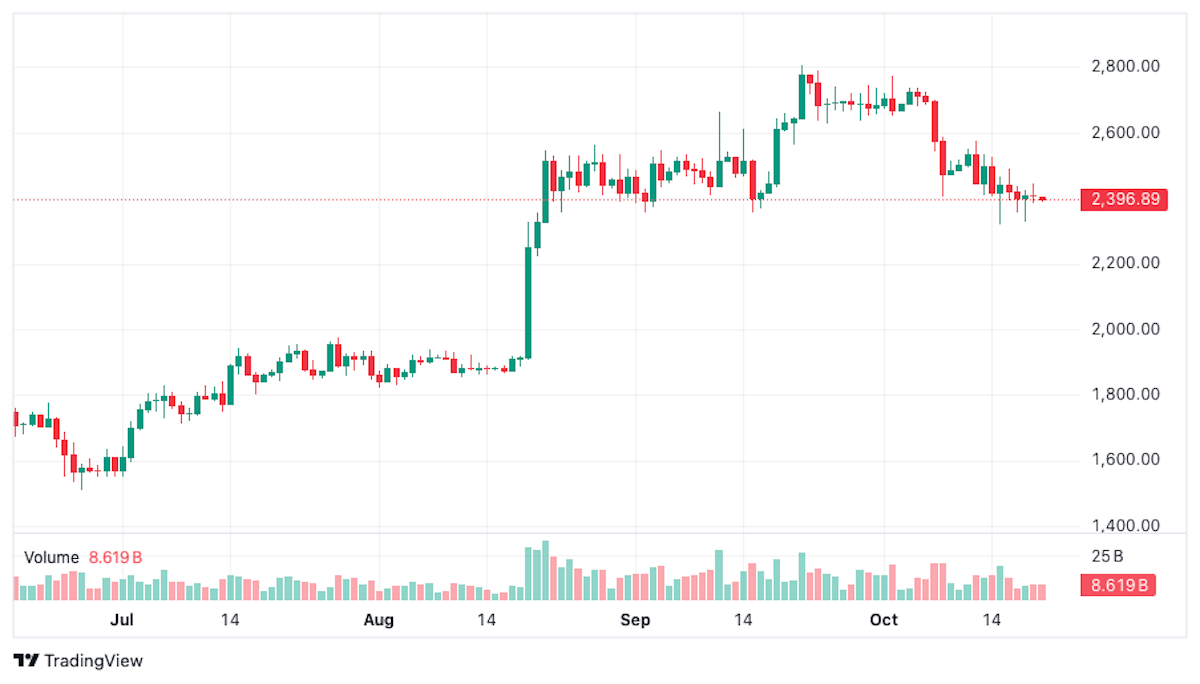
ETH reached an all-time high of approximately $4,950 on August 24, 2025, but has since entered a downward trend. The selling pressure continued into 2026, with prices dropping to around $1,500 in June, marking a decline of about 70% from its peak.
Since August, the price has rebounded, reaching $2,718 on October 6. However, continued outflows from U.S. spot ETFs, coupled with the higher-than-expected U.S. Consumer Price Index (CPI) announced on October 14, led to a decline, with prices falling to the mid-$2,300s by October 15. U.S. spot ETFs experienced nine consecutive days of outflows starting September 29, with cumulative outflows reaching approximately $697 million by October 9.
Potential catalysts for ETH include the following:
Price forecasts vary significantly among experts. Technical analysis suggests that $2,445 is a support level, while $2,800 to $3,000 is seen as a resistance level. Some predict a new all-time high by year-end, while others warn that continued ETF outflows could push prices below $2,000 again. All forecasts are subject to change based on underlying assumptions, so they should be considered as reference information only.

Since Ethereum's 2014 fundraising (ICO) where ETH was sold, there has been ongoing debate over whether 'ETH is a security.' This is the same issue that XRP faced in its lawsuit with the SEC.
The de facto resolution to this debate came on March 17, 2026, when the SEC published an interpretation regarding the classification of cryptocurrencies, with the CFTC expressing agreement on the same day. According to legal experts, this interpretation positions ETH, alongside Bitcoin, as a prime example of a 'digital commodity' rather than a security. This marks the regulatory authorities' own response to the 12-year question of whether 'ETH is a security.'
The same joint interpretation also clarified the treatment of staking. Not only direct staking by individuals but also staking through service providers and mechanisms known as liquid staking are generally not considered securities transactions.
Previously, the possibility that staking rewards could be viewed as securities dividends was a major barrier to institutional investors entering the market. With this uncertainty resolved, it has become easier to advance ETFs incorporating staking rewards and corporate ETH staking.
In the United States, a spot ETF was listed in July 2024, and in October 2025, Grayscale began staking in its existing ETF. On March 12, 2026, BlackRock listed the 'iShares Staked Ethereum Trust ETF (ETHB),' which incorporates staking rewards. ETHB stakes 70-95% of its held ETH, distributing the rewards to investors.
In Japan, the revised Financial Instruments and Exchange Act was enacted on July 15, 2026, classifying cryptocurrencies as 'financial instruments.' Regarding taxation, there is a plan to apply a flat 20% separate taxation on capital gains from as early as 2028. For ETH, the key point is that the revision allows for the creation of cryptocurrency ETFs domestically. While the target assets will be decided in the future, based on market capitalization and ETF performance in the US, ETH is seen as a strong candidate following Bitcoin.
ETH has established its position alongside Bitcoin as a 'digital commodity' in the US, resolving most regulatory uncertainties. However, there are still aspects dependent on future institutional design, such as the enactment of the market structure-defining CLARITY Act and the specific timing of ETF deregulation and tax reforms in Japan.

Ethereum developers have shifted to a strategy of implementing upgrades approximately twice a year. Following the Fusaka upgrade in December 2025, the following upgrades are planned from 2026 onwards.
Upgrade | Timing | Main Features |
Glamsterdam | Operational on the Sepolia testnet from October 6, 2026. The mainnet target is Q4 2026, although the exact date is not yet confirmed. | Introducing "ePBS" to revise block generation mechanisms and "Block-Level Access List" for parallel transaction processing, significantly boosting processing capacity. |
Hegotá | Development begins after Glamsterdam | Mandating "FOCIL" to prevent transaction censorship and "Frame Transactions" for quantum-resistant signatures. |
Subsequent Upgrades | Until 2029 | Gradual introduction of quantum computer resistance. |
Glamsterdam is considered the largest upgrade since "The Merge," symbolizing a strategic shift to enhance processing capacity within Ethereum itself, previously delegated to Layer 2 solutions.
In September 2026, the Ethereum Foundation's protocol team set a goal to make the entire Ethereum infrastructure resistant to quantum computers by December 2029. This plan anticipates the possibility of "Q-day," when quantum computers could break cryptography, arriving as early as 2030.
Achieving this goal requires upgrades approximately every seven months, leaving little room for delay. Vitalik Buterin has prioritized privacy and quantum resistance, proposing the "Lean Ethereum" initiative to reconstruct the core protocol components.
Public companies holding ETH as a financial asset play a crucial role in supporting its price. The largest, BitMine, has been increasing its holdings since June 2025, owning approximately 6.01 million ETH (about 4.9% of total supply) as of October 4, 2026. Of this, around 5.07 million ETH are staked, with an expected annual staking income of about $360 million. However, with the 5% target approaching, the purchase pace has slowed for two consecutive weeks.
Unlike Bitcoin treasury companies, ETH treasury companies benefit from staking yields. However, proposals to reduce staking rewards are under discussion, which could impact these companies' revenues.
Despite technological and regulatory advancements, ETH's price may not necessarily rise proportionately. Key considerations include supply and demand, supply design, competitive environment, and operational methods.
ETH fell about 70% from its peak in August 2025 to June 2026. While institutional investments through spot ETFs and treasury companies can drive prices up, outflows can exert significant selling pressure. In October 2026, outflows continued from U.S. spot ETFs.
With increased transactions on Layer 2, Ethereum's mainnet fees have decreased, reducing the amount of fee burning. In 2026, burning offsets only a small portion of new issuance, leading to a net supply increase. There is criticism that increased network usage does not easily translate into ETH value.
Competition with faster and cheaper blockchains like Solana is intense. Additionally, the Ethereum Foundation has seen a series of executive departures, and ETH sales by the foundation are noted as potential price dampeners. Delays or issues with major upgrades could also undermine trust.
While staking offers yields, there may be delays in withdrawing staked ETH. Staking through service providers carries risks of fraud or bankruptcy. Furthermore, the futures market has accumulated significant leveraged positions, making forced liquidations more likely during sudden market shifts.
ETH is one of the major assets, yet its price has dropped to nearly a third within less than a year. When seeking yields through staking, investors should consider the potential for significant principal reduction when determining investment amounts.

Ethereum has served as the "world computer" capable of running programs on the blockchain, forming the foundation of Web3.0 with applications in DeFi, stablecoins, and asset tokenization. Its decentralized development structure, free from reliance on specific companies, and its uninterrupted reliability since 2015 are major reasons it is favored by institutional investors.
By 2026, the SEC and CFTC have explicitly classified ETH as a "digital commodity," and the legal framework for staking has been clarified. The presence of BlackRock's staking ETF and treasury companies like BitMine is also growing. A major upgrade, Glamsterdam, is set for deployment by the end of the year, with a long-term goal of achieving quantum resistance by 2029.
Meanwhile, the price has significantly declined from its peak in August 2025, and there is ongoing capital outflow from ETFs. The reduction in fee burning leading to a net increase in supply and challenges surrounding the Ethereum Foundation's management remain issues.
While Ethereum's technological roadmap, including Glamsterdam and quantum resistance, is ambitious, whether this will be reflected in its price is another matter. It is crucial to separate technological advancements from the mechanisms that link them to ETH's price, and to make informed decisions by monitoring upgrades and capital flows.

Yes, it is possible. There are registered operators in Japan offering ETH staking services, but the available tokens, reward rates, withdrawal periods, and fees vary by provider. Operating your own validator requires 32 ETH and technical knowledge.
Yes, they are. According to the National Tax Agency, ETH received from staking must be recorded as income at its market value at the time of receipt. Similar to capital gains, under the current system, it is generally subject to comprehensive taxation as miscellaneous income. Whether the approximately 20% separate self-assessment taxation, expected to be introduced as early as 2028, will apply to rewards needs to be confirmed by future legislation.
Usually, no action is required. If ETH is held in an exchange, the operator will handle it, and ETH in self-managed wallets can be used as is. Be cautious of communications suggesting that ETH needs to be transferred in line with the upgrade, as they are likely scams.
Bitcoin has a capped supply and is primarily an asset for value preservation. In contrast, ETH has no supply cap and functions as "network fuel," generating fees for smart contract usage and staking rewards. The factors influencing their prices differ, so they should be considered separate assets when held together.