


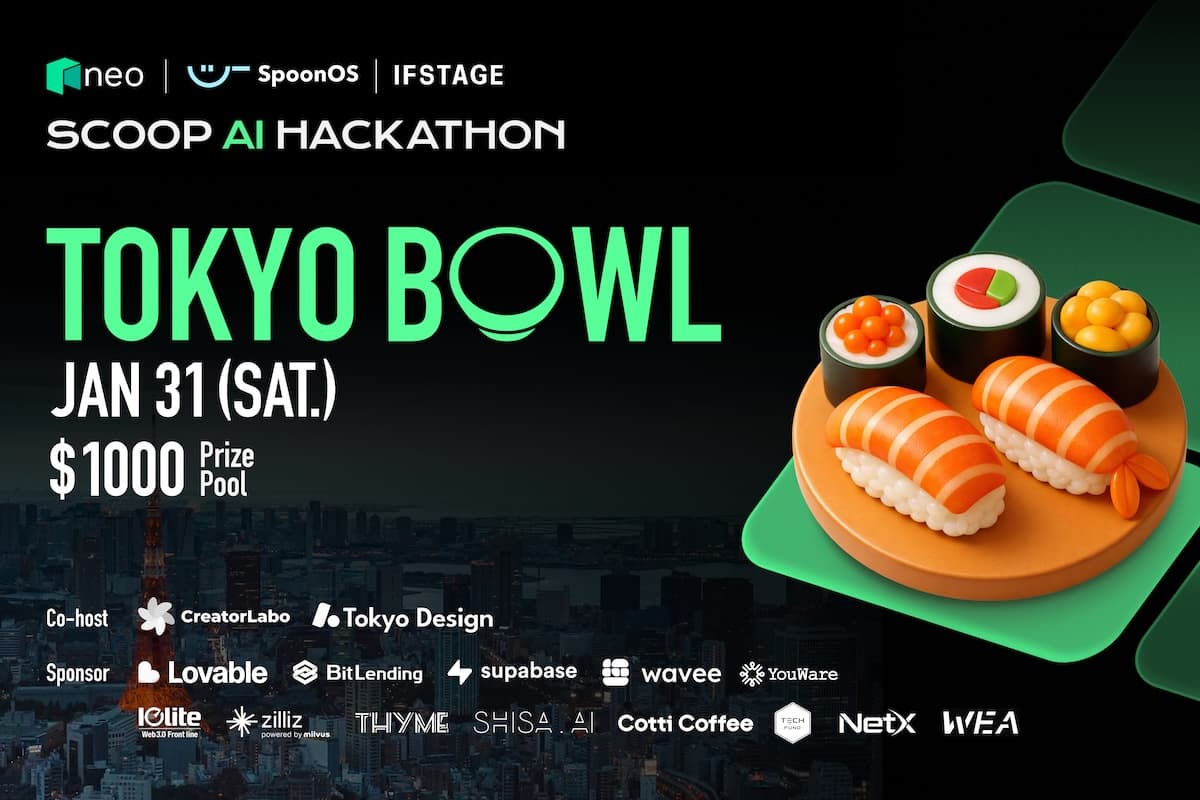
On January 31st, the 'Scoop AI Hackathon Tokyo Bowl' was held at the MIDORI.so Shibuya / CryptoBase shared office space in Tokyo.
The 'Scoop AI Hackathon' is an international hackathon series sponsored by the layer 1 blockchain Neo and its next-generation platform 'SpoonOS', which integrates AI with Web3.0, aiming to realize a smart economy. It brings together developers from around the world to practically explore the potential of AI agent technologies.
This Tokyo event not only featured the hackathon but also incorporated meetup elements. The event saw a robust turnout, with an estimated 40-50 participants.
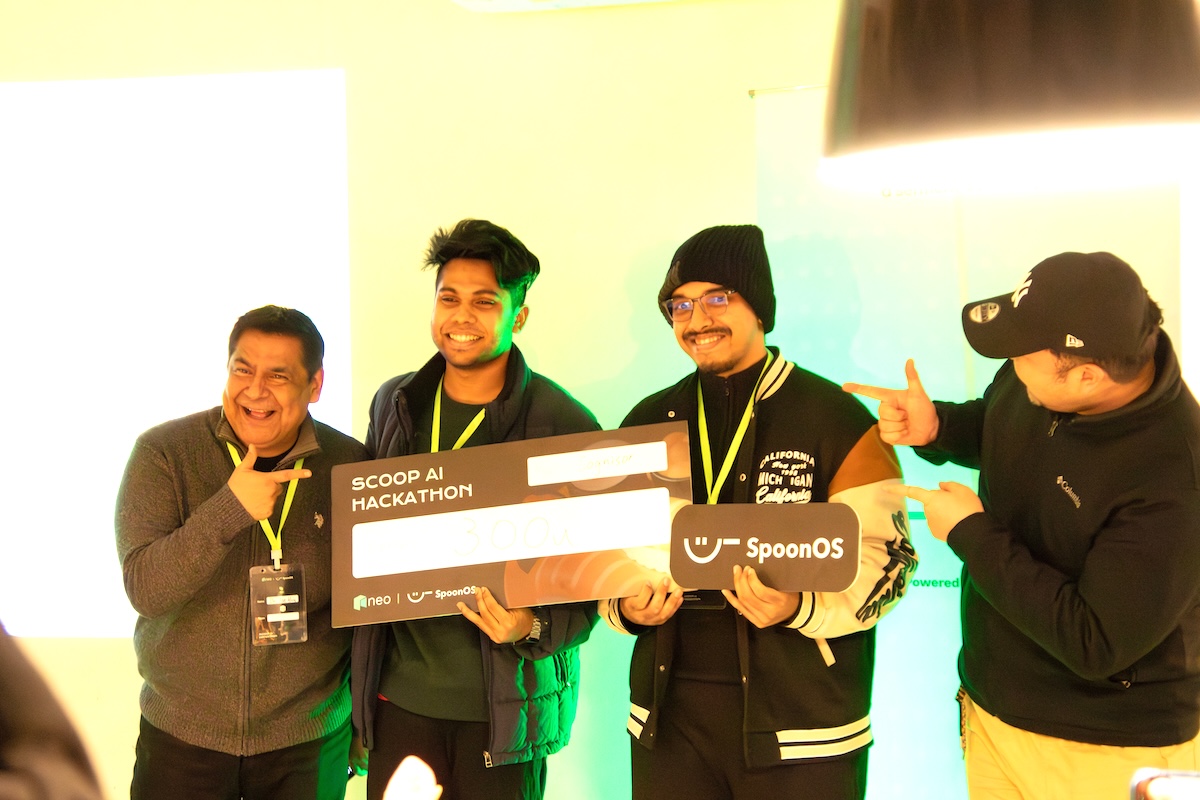
The winners of the 'Scoop AI Hackathon Tokyo Bowl' were Farhan Morshed and Irfan Faisal, who teamed up as 'Cognisor'.
Media partner Iolite, participating in this event, conducted interviews with both distinguished winners.
──What motivated you to participate in the 'Scoop AI Hackathon Tokyo Bowl'?
Falhan Morshed (hereafter, Farhan): Hackathons have always been a testament to my skills and a major part of shaping who I am today. I love hackathons because, within a very short time, they allow me to work intensively, challenge myself, and test everything I have learned under real pressure. I worked day and night teaching myself new skills, not just for this event, but throughout my journey. Hackathons give me the space to turn ideas into reality quickly, and that process continuously pushes me to grow.
Irfan Faisal (hereafter, Faisal): I am naturally drawn to challenging competitions where I can test my practical knowledge under pressure. Hackathons like ScoopAI are not just about ideas—they demand fast learning, problem-solving, and execution. I wanted to evaluate how well I could design and build a real AI-driven solution within a limited time while competing with strong teams from different countries.
──What kind of work or projects do you usually engage in?
Farhan: I am usually involved in building AI-driven initiatives that solve real, personal problems. One of my main projects focuses on developing a platform to help students get jobs faster through better guidance, automation, and decision support.
Another project is Netlink AI, an artificial brain for networking. I attend many events, but like most people, I used to forget whom I met and how to follow up. Netlink AI connects meetings, remembers interactions, and helps grow professional networks intelligently.
Alongside this, I am the founder of Tokyo International University Impact Next, where we help students build ideas and scale products in Tokyo. We work closely with Japanese students, government bodies, and corporate partners to turn student ideas into real-world impact.
Faisal: I am mainly involved in technology-focused projects, especially around AI development, automation, and digital product building. My work often includes designing AI-powered tools, experimenting with LLMs, building web-based AI applications, and creating systems that solve real-world productivity or decision-making problems rather than purely theoretical models.
──Please tell us about the highlights and focus points of your winning presentation.
Farhan: Our presentation focused on Flow, a voice-first AI productivity operating system. Flow was born from a real problem I personally faced—managing too many disconnected calendars, task apps, notes, and responsibilities. Every morning felt less about executing work and more about deciding what to prioritize.
Flow changes that experience entirely. With a single command like “Plan my day,” it creates a complete, balanced schedule and executes it instantly. Flow doesn’t just organize tasks—it organizes life. Our main focus was productivity and reducing decision fatigue, showing how AI can handle complexity so people can focus on meaningful, high-impact work.
Faisal: Our winning presentation focused on Flow, a voice-first AI productivity agent designed to reduce decision fatigue and fragmented task management. Instead of adding another task manager, Flow acts as an execution-oriented assistant that converts natural voice commands into structured plans and actions.
The key points we focused on were:
Clear problem definition: People don’t struggle with tools—they struggle with overload and constant prioritization.
Practical AI usage: Using voice input and AI reasoning to plan, prioritize, and execute tasks automatically.
Real-world feasibility: Emphasizing realistic usage for busy professionals, founders, and students.
Human-centered design: Ensuring AI supports decision-making rather than replacing it.
──What are your future activities and goals?
Farhan: Looking forward, I want to support young founders in Japan by helping them adopt AI automation in practical and scalable ways. I aim to grow my platforms to a level where they can be supported by major accelerators and angel investors. Ultimately, my goal is to build systems that empower people—especially students and early-stage founders—to move faster, think clearer, and create real impact.
In addition, I am currently working on the development of Cognisor AI, an AI-driven innovation and automation studio. Cognisor AI is designed to help early-stage founders and startups in Japan scale more efficiently through intelligent systems, product strategy, and applied AI solutions.
For those interested, please find more details at the link below.
Faisal: I want to deepen my expertise in AI system design, especially in building and fine-tuning AI models that are reliable, explainable, and useful in real-life scenarios. Beyond technical growth, one of my long-term goals is to build an AI-focused community where students, builders, and professionals can collaborate and create impactful AI-driven solutions.
SpoonOS Official X (formerly Twitter): https://x.com/spoonos_ai
Neo Official X (formerly Twitter): https://x.com/Neo_Blockchain
Neo Japan Official X (formerly Twitter): https://x.com/NeoWorldJapan
SpoonOS Web3 Skills Marketplace:https://skills.spoonai.io/

