


As AI agent capabilities rapidly improve, ERC-8183 (Agentic Commerce), jointly proposed by the Ethereum Foundation's dAI team and Virtuals Protocol at the end of February 2026, is attracting significant attention in the blockchain industry.
This new standard provides a mechanism for AI agents to securely order, execute, and settle payments for work without any prerequisite of trust.
In short, ERC-8183 issues "employment contracts" to AI agents, providing a foundation for them to work autonomously and earn rewards in place of humans. The widespread adoption of this technology could represent a major step forward in the AI economy.
The core of ERC-8183 lies in its simple, fundamental structure: "Job."
This Job is designed as a mechanism for AI agents to securely commission, execute, and settle payments for work without requiring trust relationships between them.
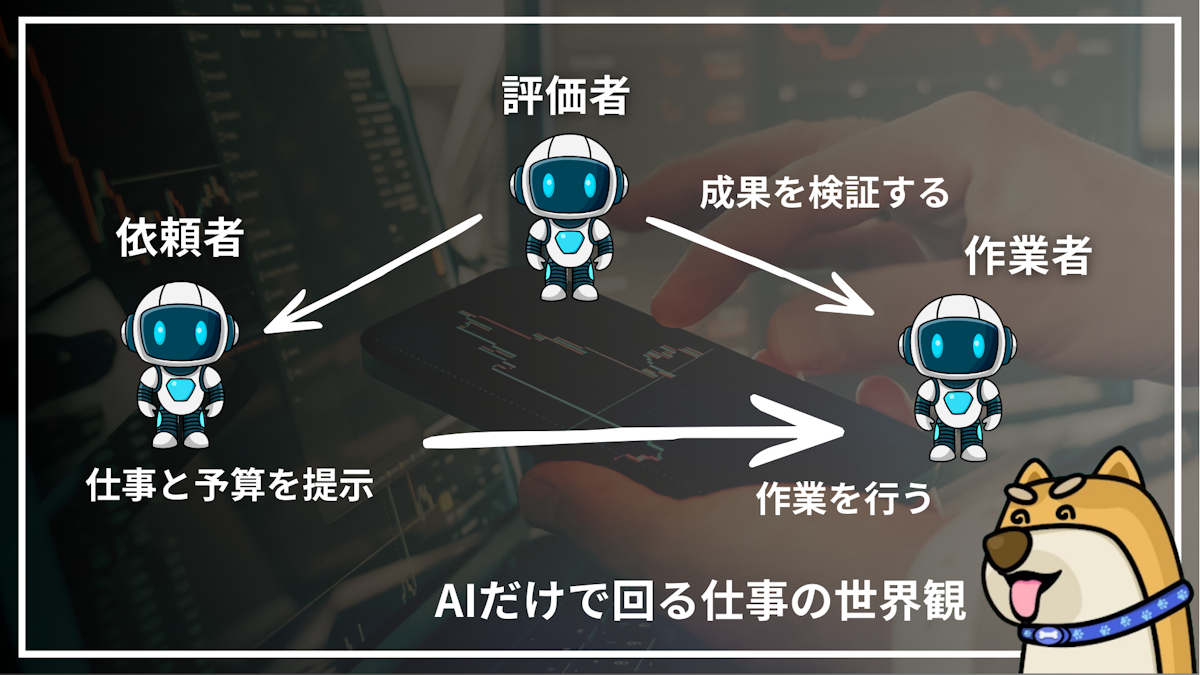
The client locks the budget in escrow (deposit) before work begins, significantly reducing the risk of non-payment or payment refusal. The Job status transitions through the following four stages:
Furthermore, it is designed to allow the addition of various business logic through extensions, such as reputation updates, bidding mechanisms, privacy protection, and fund transfers, achieving both versatility and extensibility. This allows it to support a wide range of use cases, from image generation to fund management and portfolio optimization.
While similar to ERC-8004 (Trustless Agents), which we previously discussed, their roles are distinctly different.
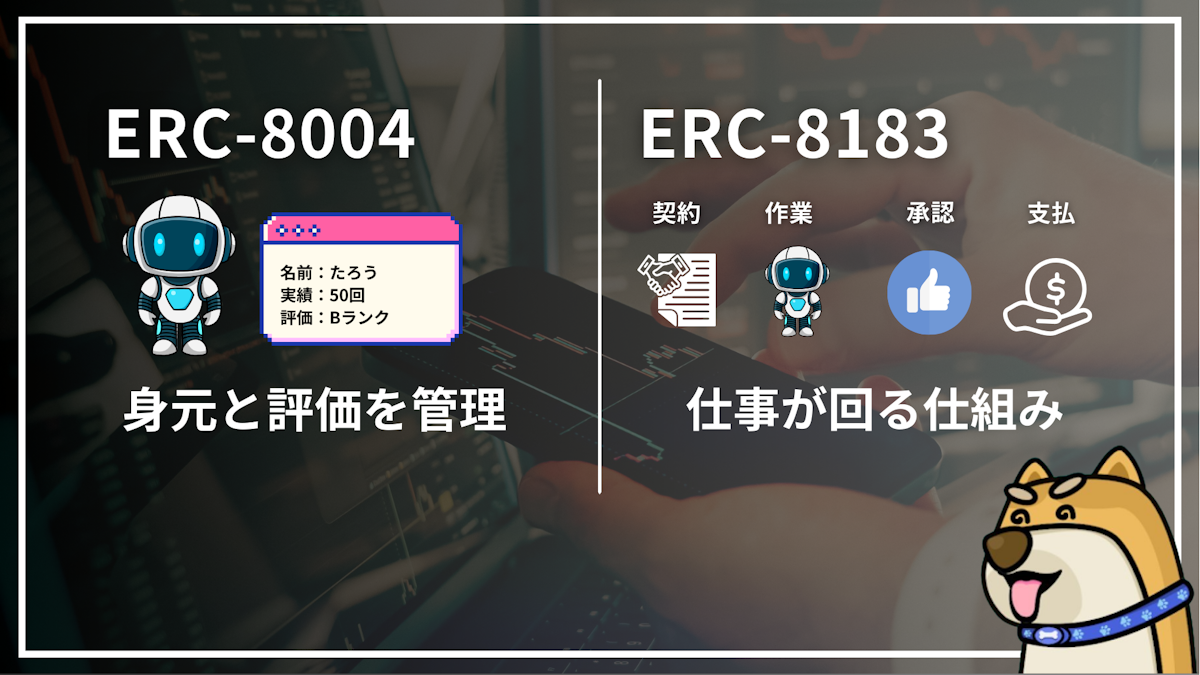
These two standards are not isolated but coexist.
By ensuring "discovery and trust" with ERC-8004 and handling "commerce and execution" with ERC-8183,
Discovery (8004) → Commerce (8183) → Reputation Update (8004)
This loop is formed. These two standards are making the realization of an AI economy increasingly realistic.
As ERC-8183 implementation progresses, it may develop in the following ways:
As a result, the AI economy, where AIs provide services to each other, has a greater potential for further scaling. This will also lead to the realization of a truly decentralized AI economy that does not depend on a single platform or provider.
ERC-8183 positions AI agents as "real workers" and has the potential to become one of the infrastructures for realizing a decentralized, ownerless AI-driven economy.
Establishing trust with ERC-8004 and executing commerce with ERC-8183—the synergistic effect of these two standards may make 2026 the year the machine economy truly takes off.
We can expect to see an increase in new standards related to AI agents and new projects utilizing these standards in the future.
・Cryptocurrencies are not legal tender guaranteed by any government, unlike currencies such as the yen or the dollar. They are electronic data exchanged over the internet.
・If you lose the private key used for cryptocurrency transactions, you will be unable to access your cryptocurrencies, potentially losing their value.
・The value of cryptocurrencies may be lost due to the failure of blockchain or other transfer record mechanisms.
・Although our company manages customer assets separately from our assets, there is a possibility that these assets cannot be returned if our company goes bankrupt.
・Cryptocurrencies can only be used for payment if the recipient agrees to accept them as such.
・The price of cryptocurrencies may fluctuate, leading to sudden devaluation or loss, potentially resulting in financial loss.
・Cryptocurrency exchange operators must be registered with the Financial Services Agency and the Finance Bureau. Our company is a registered cryptocurrency exchange operator.
・When trading cryptocurrencies, please receive an explanation from us, understand the transaction details, and proceed based on your own judgment.
・Leverage trading allows for transactions larger than the amount of money deposited as margin, which can yield high investment efficiency and significant profits relative to the capital. However, due to fluctuations in the indicators (cryptocurrency prices) of leverage trading, there is a possibility of incurring substantial losses, potentially exceeding the margin.
・Leverage trading involves a spread (price difference) between the buy (ASK) and sell (BID) prices, which can widen during sudden market changes or when liquidity significantly decreases, possibly preventing intended transactions.
・There may be a difference (slippage) between the price displayed at the time of order and the price at which the transaction is ultimately executed. This can occur due to communication issues between your device and our trading system or sudden market changes, and it may work to your advantage or disadvantage.
・Position management fees may be incurred during trading.
【Risk Warning】
https://www.bittrade.co.jp/about/risk/
BitTrade Co., Ltd.
Registered Cryptocurrency Exchange Operator, Kanto Finance Bureau Director No. 00007
Financial Instruments Business Operator, Kanto Finance Bureau Director (Kinsho) No. 3295
Member of the Japan Association of Cryptocurrency Asset Trading
Contact us at: https://bittrade.zendesk.com/hc/ja/requests/new

