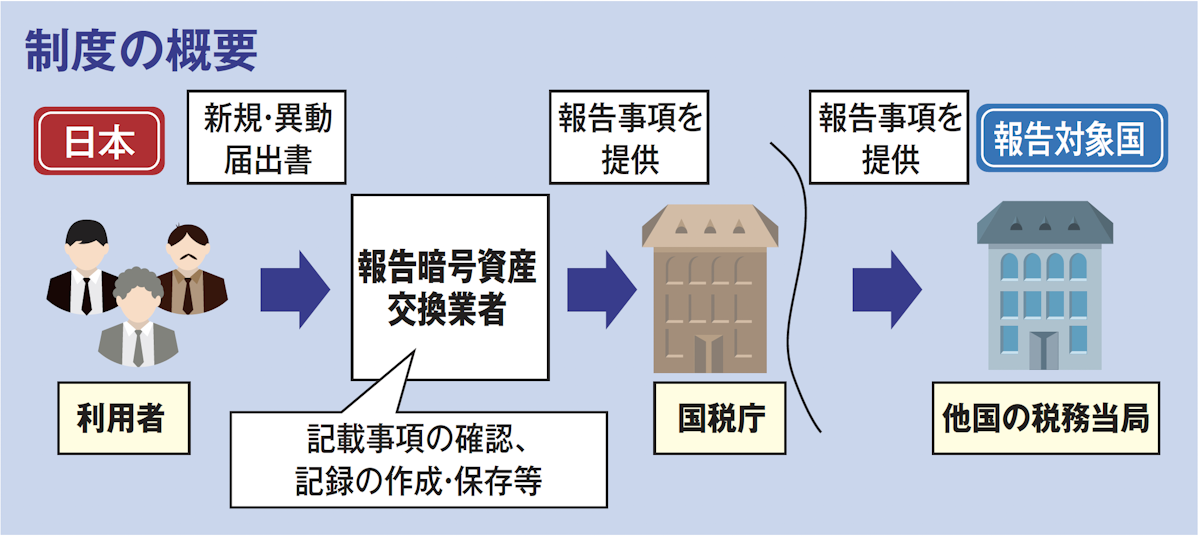
Japan’s version of CARF establishes a new reporting framework designed to prevent cross-border tax evasion and avoidance involving crypto assets. Under this system, crypto-asset exchanges and related service providers are required to report transaction information of non-residents to the National Tax Agency (NTA), which will then automatically exchange this data with foreign tax authorities.
Based on the OECD’s international framework, the system came into force in January 2026, with full-scale information exchange among participating countries expected to begin from 2027. Crypto assets are now clearly positioned as “borderless assets” subject to enhanced global tax oversight.
Individuals engaging in crypto-asset transactions must submit declarations to exchanges that include their name, address, date of birth, country of tax residence, and foreign taxpayer identification number, where applicable.
Any changes to this information must be reported promptly. Inaccurate or false declarations may result in future tax risks. This marks a clear shift away from the assumption of anonymity in crypto-asset transactions.
Crypto-asset exchanges are required to collect, verify, record, and store information related to reportable contracts, and submit detailed reports to tax authorities by the end of April each following year.
Reportable data includes user identification details, countries of residence, types of crypto assets traded, and aggregate transaction values.
As operational burdens and system requirements increase, exchanges are expected to balance strict compliance with practical implementation, making robust governance and reporting capabilities essential.
As part of Japan’s FY2024 tax reform, a new reporting framework—commonly referred to as Japan’s CARF—was introduced to address international tax evasion and avoidance involving crypto assets. Under this framework, crypto-asset exchanges and related service providers are required to report transaction information concerning non-resident users to the National Tax Agency (NTA), which then shares the data with foreign tax authorities.
The framework took effect on January 1, 2026, requiring domestic exchanges to collect customer transaction data throughout the year and submit the relevant reports by the end of December.
The primary objective of this framework is to enhance transparency in crypto-asset transactions and promote the automatic exchange of tax information across jurisdictions. As crypto regulation tightens, both exchanges and users are now required to implement new compliance measures.
Japan’s CARF is based on the Crypto-Asset Reporting Framework (CARF) developed by the OECD. Participating countries are expected to begin information exchange by 2027. As of December 4, 2025, 76 countries and jurisdictions have committed to implementing CARF between 2027 and 2029.
Under Japan’s CARF framework, exchanges must receive declarations from users, verify the submitted information, create and retain records, and submit required data to the NTA (via the relevant local tax office). Information relating to non-resident users is then transmitted by the NTA to overseas tax authorities.