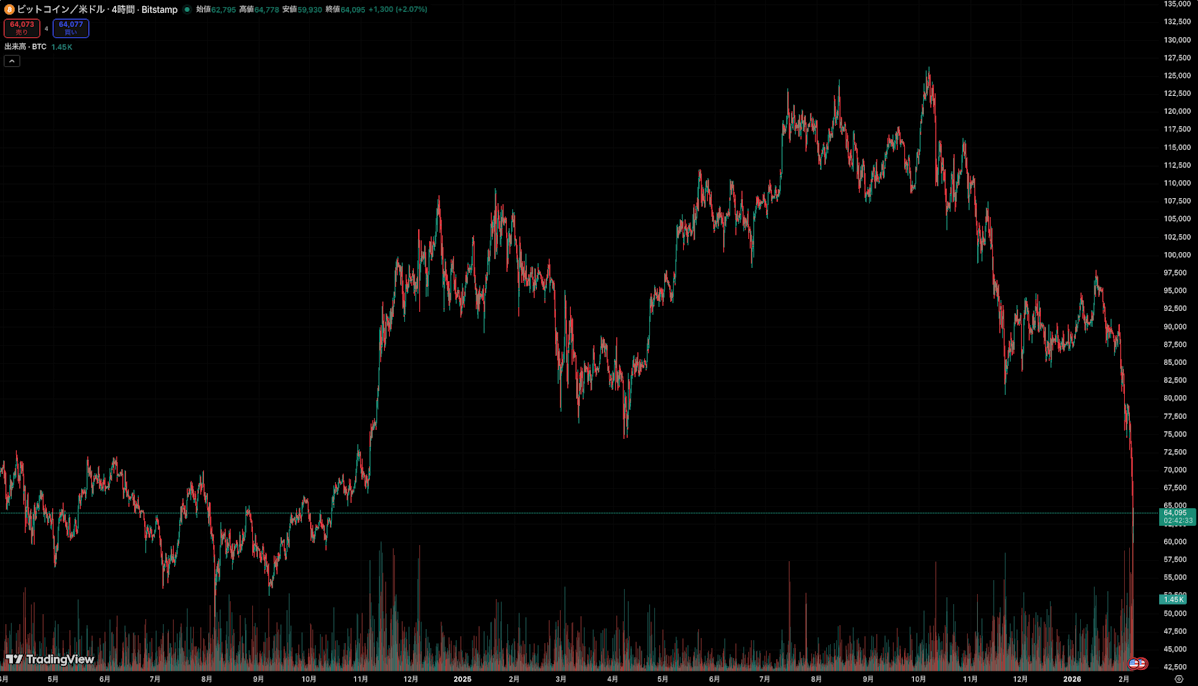
As of February 6 – 4-hour chart (Source: TradingView)
Bitcoin recorded fresh year-to-date lows on consecutive days this week. The initial trigger was U.S. President Donald Trump’s nomination of Kevin Warsh—widely regarded as a monetary hawk—as the next chair of the Federal Reserve.
The announcement unsettled markets that had been pricing in a shift toward monetary easing, rapidly heightening risk aversion across risk assets.
Subsequently, gold—long viewed as a safe-haven asset—posted its largest decline in 46 years. This move sparked a broader sell-off in equity markets, particularly in technology stocks, and spillover selling pressure reached the cryptoasset market in the form of loss-covering trades, reflecting cross-asset deleveraging.
As a result, Bitcoin fell below the psychologically significant $70,000 level.
Additional downward pressure came from reports that discussions at the White House over the “Clarity Act,” a proposed regulatory framework for cryptoassets, failed to reach an agreement. Uncertainty surrounding the future of regulation dampened investor sentiment further, accelerating the price decline.
Recent Key Economic Indicators & Crypto Events
Key Events (by Date)
The Impact of Financial Deterioration at DAT Companies on the Cryptoasset Market
DAT (Digital Asset Treasury) companies are firms that hold large amounts of cryptoassets, such as Bitcoin, as part of their corporate treasury.
A well-known example is U.S.-based Strategy, but DAT companies share a structural vulnerability: when cryptoasset prices fall below a company’s average acquisition cost, they are prone to entering a “negative feedback loop.”
First, as unrealized losses on their holdings expand and impair the balance sheet, investor confidence erodes and share prices decline. A falling stock price weakens the company’s ability to raise capital. Equity financing becomes difficult due to dilution concerns, and the firm loses the capacity to purchase additional cryptoassets. At the same time, market anxiety grows over the possibility that the company may be forced to sell its holdings, which itself puts further downward pressure on cryptoasset prices.
If financial deterioration persists, even the company’s listing status can come under threat. In U.S. markets, firms facing insolvency risks or doubts about their ability to continue as a going concern are subject to strict reviews and may be required to submit remediation plans. If a credible path to capital recovery cannot be demonstrated, delisting becomes a real possibility. Japan’s Tokyo Stock Exchange Standard Market operates under similarly clear rules. Companies that fall below maintenance standards—such as minimum net assets or market capitalization—are generally granted a one-year grace period to improve their situation, but failure to do so can result in being designated as a supervised or liquidation issue, ultimately leading to delisting. For DAT companies that rely heavily on external financing to continue acquiring cryptoassets, this institutional risk cannot be ignored.
※Image generated by AI
The behavior of these firms also affects the broader cryptoasset market. To date, DAT companies have functioned as consistent buyers, helping support market demand. A decline in their financing capacity therefore does not simply translate into increased selling pressure; more critically, it removes a structural source of buying demand. As a result, the market’s upward momentum is significantly weakened.
In conclusion, DAT companies face an inherent risk of falling into a negative spiral: “price declines → expanding unrealized losses → falling share prices → reduced fundraising capacity → purchase suspensions and fears of forced sales → further price declines.” This self-reinforcing cycle represents the core vulnerability of the DAT business model.
Interview: Iolite FACE vol.18 Takeshi Chino, Representative Director, Binance Japan
PHOTO & INTERVIEW: Mai Shin
Special Features:
“Future Money — The Current State of Value Transfer”
“Upcoming Amendments to Japan’s Crypto Asset Regulations”
“The Reality of IEOs”
Crypto Journey
Beyond a Treasury Company: Becoming an Ethereum Evangelist —
The Essence and Determination Behind HODL1’s Digital Asset Treasury (DAT) Strategy
Interview with Hiroki Tahara, Representative Director, Kusim Inc. (now HODL1)
Series: “Expert Perspectives on Interpreting Volatile Crypto Markets” — Kasou NISHI
Series
Tech and Future — Toshinao Sasaki
…and more
MAGAZINE
Iolite Vol.18
March 2026 issueReleased on 2026/01/30
Interview: Iolite FACE vol.18 Takeshi Chino, Representative Director, Binance Japan
PHOTO & INTERVIEW: Mai Shin
Special Features:
“Future Money — The Current State of Value Transfer”
“Upcoming Amendments to Japan’s Crypto Asset Regulations”
“The Reality of IEOs”
Crypto Journey
Beyond a Treasury Company: Becoming an Ethereum Evangelist —
The Essence and Determination Behind HODL1’s Digital Asset Treasury (DAT) Strategy
Interview with Hiroki Tahara, Representative Director, Kusim Inc. (now HODL1)
Series: “Expert Perspectives on Interpreting Volatile Crypto Markets” — Kasou NISHI
Series
Tech and Future — Toshinao Sasaki
…and more