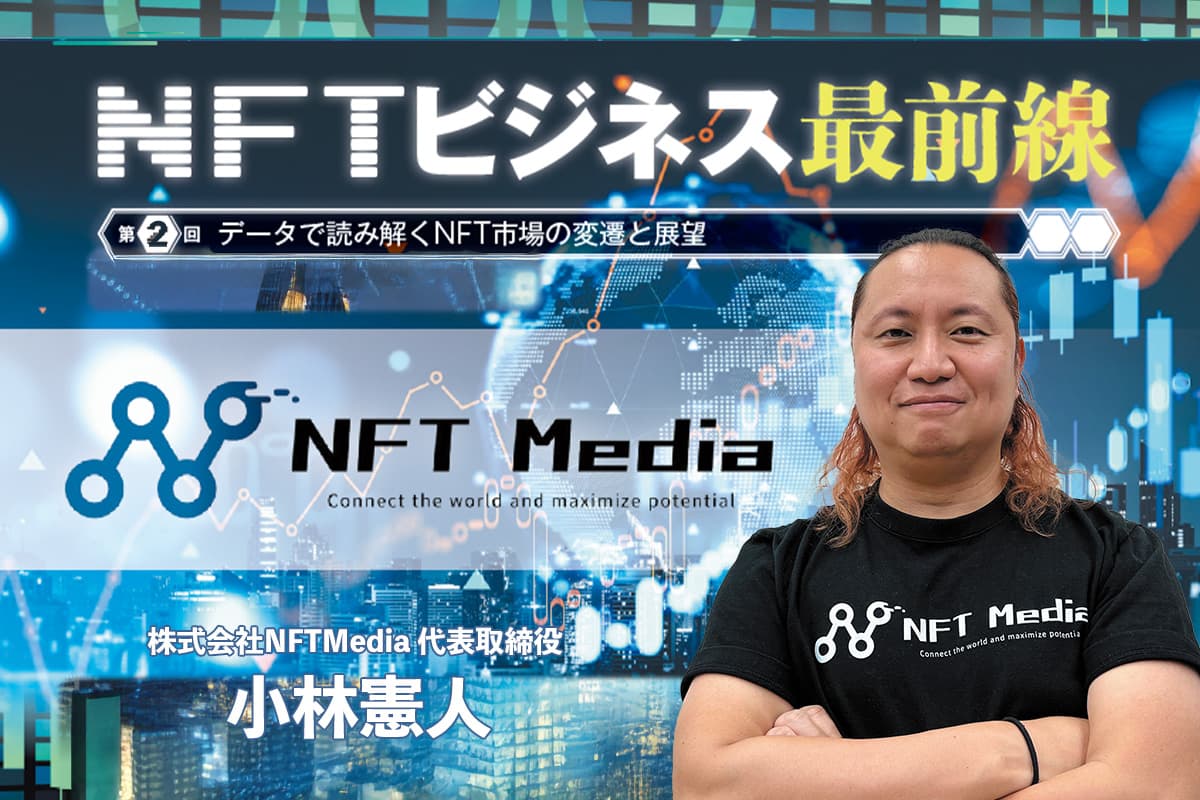
The No. 1 question I get asked at networking events is "What's the current state of NFT?" So this time, I'll tell you about the current state of NFT with some numbers.
From 2021 to 2022, the NFT market was in a frenzy. However, after that, global monetary tightening and turmoil in the cryptocurrency industry overlapped, and investment money flowed out of NFT, which is a risky asset. In particular, the NFT art market, which was a symbol of the boom, fell sharply from its peak of about $2.9 billion (about 320 billion yen at the time) in 2021, shrinking to just $197 million (about 29.1 billion yen at the time) in 2024. This is a decrease of about 93% from the peak.
However, I do not see this as the end of NFT, but the beginning of a healthy structural transformation for the market to move to the next stage. According to the latest tally from data analysis site CryptoSlam, total NFT trading volume in May 2025 was $476.39 million (approximately 74.3 billion yen), up approximately 28% from the previous month's $373.5 million (approximately 58.3 billion yen).
In addition, the number of buyers exceeded 1.04 million, up approximately 67% from approximately 620,000 in the previous month, reaching a level not seen since October 2024.

Now that the speculative frenzy has calmed down, the source of value for NFTs has clearly shifted from aspects such as rarity and expectations of price increases to more essential elements. Specifically, these include practicality, such as being able to receive actual products when you hold an NFT, authenticity, which backs up the value of objects in the real world and secures assets (e.g., authenticity of trading cards), and scalability as IP (intellectual property) that goes beyond the digital space.
Let me give you a very easy-to-understand example. It is the IP business "Pudgy Penguins," which was originally an NFT project. With the enthusiastic support of the community, this project expanded its influence as an IP beyond the digital world, such as selling stuffed toys at major retailer Walmart.
As a result, the trading volume in 2024 increased 140% from the previous year to $786 million (approximately 116.3 billion yen at the time). This is an example of how NFTs have shown a new path to nurturing IP together with the community and monetizing it as a business.

Another iconic example is "NOT A HOTEL," which operates luxury villa hotels. They have converted the right to stay at a hotel on a specific date each year into an NFT, rather than the ownership of the property itself. This is a practical example of RWA (tokenization of real assets), which tokenizes rights backed by real-world asset value.
NFT holders are given an NFT "THE KEY," which is an NFT for the right to stay at a hotel for one night each year, and if they do not use it, they can freely buy and sell it on the marketplace. It has attracted a lot of attention as a groundbreaking model that brings asset value and flexibility to membership rights.
Research organizations' predictions for the future of the NFT market show a bright outlook. According to an analysis by Grand View Research, the global NFT market is expected to expand from $26.9 billion (approximately 3.766 trillion yen at the time) in 2023 to $211.7 billion (approximately 30.5 trillion yen as of June 2025) in 2030, achieving an astounding average annual growth rate of 34.5%.
The drivers of growth are also changing, with areas that emphasize practicality such as tokenization of real assets, commercial use, and utility NFTs emerging.
In Japan, NFTs are also accelerating their social implementation in local government tourism policies, real estate, ticket sales, and more.
NFTs are beginning to penetrate into everyday life as a practical infrastructure, which is evidence that the market is beginning to move into the next phase.
The NFT market is now at a major turning point.
Looking back at history, this overlaps with the path the Internet took in the 1990s.
I started NFT Media because I thought that if a world where NFTs are used were realized, humanity would have more options, and more options would mean more people would feel happy.
In order for NFTs to become one of the foundations of society, we will continue to provide information so that NFTs are not just a speculative target, but a practical tool to solve social issues. If you want to know more about NFTs, please check out NFT Media first.
NFT Media is one of Japan's largest NFT media outlets, delivering the latest information on NFTs. We provide a wide range of information on NFTs, from beginner-friendly explanatory articles to business use cases, overseas trends, and exclusive interviews.

Showcasing the Latest Examples of NFT Marketplaces in Japan and Abroad | BALANCe