


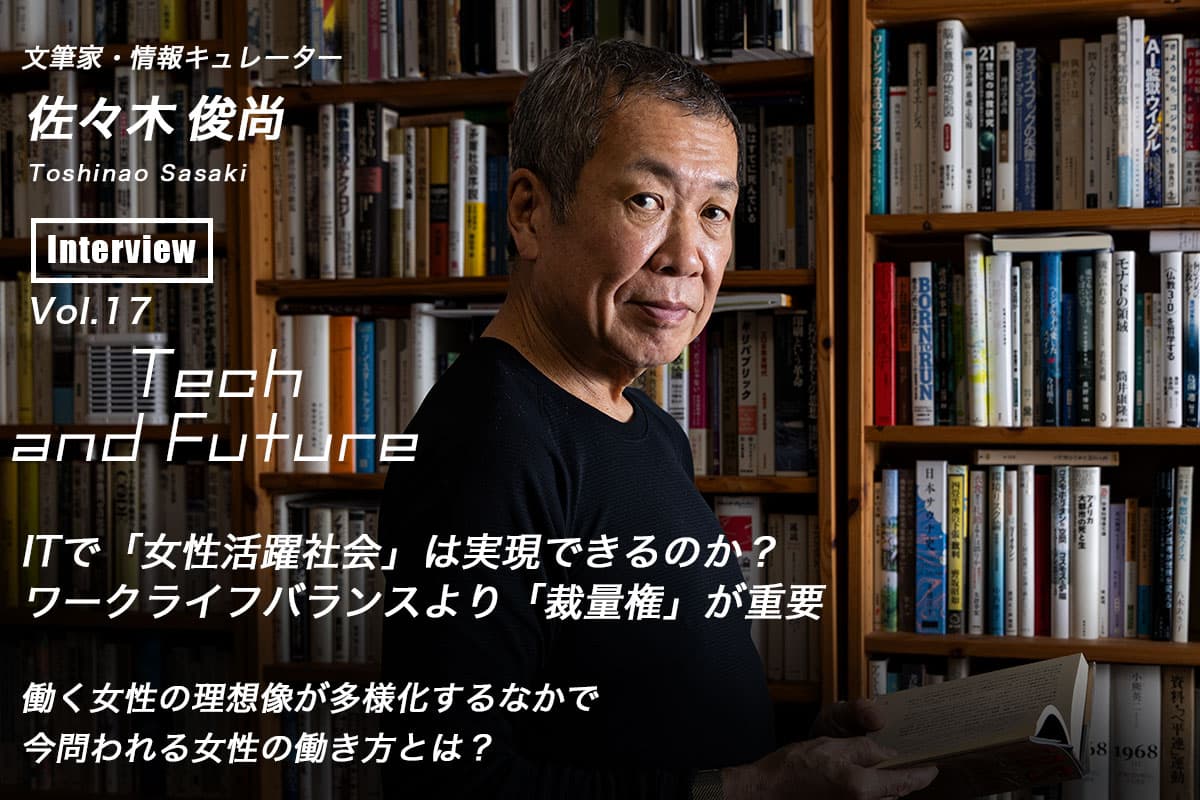
Journalist Toshinao Sasaki argues that the most overlooked issue in discussions about promoting women’s participation in the workforce is autonomy in how people work. He points out that improving work-life balance alone won’t solve the problem. Even after remote work became widespread, tighter monitoring reduced employees’ freedom, leaving many frustrated because they cannot decide how to work on their own.
The fact that women’s prime career-building years (late 20s to around 30) overlap with the ideal age for having children has led to delayed and later-in-life childbirth. This is not unique to Japan—urbanized countries face the same challenge. The situation highlights a growing mismatch between what the state expects when it urges women to “shine” in society and what actually contributes to individual happiness.
Sasaki emphasizes that technological innovation is essential to reshaping how we work. Smart glasses, the metaverse, and autonomous driving powered by generative AI will be key to eliminating the constraint of physical distance. If the cost of mobility drops dramatically, the relationship between urban centers and suburbs will shift, potentially breaking down long-standing structural barriers that have made it difficult to balance childcare and career.
Seeing the criticism of LDP President Sanae Takaichi's comment that women should "work like a workhorse," I feel a contradiction in promoting women's participation in the workforce. What do we need to realize a society in which women thrive?
Sasaki Toshinao (hereinafter referred to as Sasaki): Recently, I've been advocating the importance of "discretion" over "work-life balance." Whenever we discuss work-life balance, self-employed people always respond with, "I want to work more, so why should my working hours be reduced?"
Self-employed people can control the amount and distribution of their work at will, so they can take time off whenever they want. In other words, self-employed people have discretion.
On the other hand, company employees have no discretion over their hours or work style, and even as remote work has become more common since the COVID-19 pandemic, their freedom has been restricted, with their work monitored by PC monitoring software. This has resulted in a situation in which "even remote work lacks discretion." Furthermore, surveys of company employees reveal complaints that "it's too white-collar, so I can't remember my work."
In short, maintaining a work-life balance doesn't solve everything. This dissatisfaction is exacerbated by the problem that when work becomes completely remote, there is a lack of communication with colleagues and work doesn't function properly.
For this reason, the current mainstream working style is a "hybrid" model, where employees come into the office only two or three days a week, but the real issue isn't the choice between "remote work" or "in the office," but rather the degree to which employees can work at their own discretion.

