


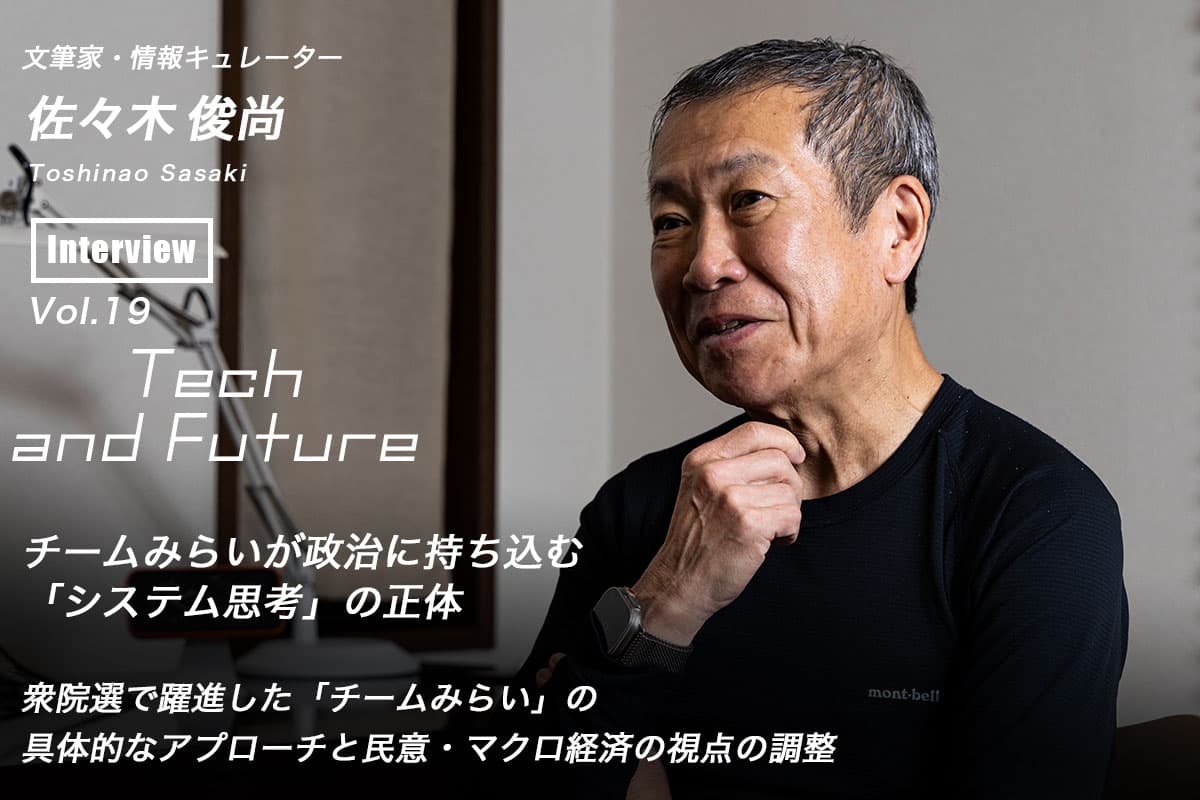
Team Mirai is introducing “system thinking” into politics—an approach that focuses not on individual policies, but on redesigning the decision-making process itself. By continuously collecting public opinion through digital platforms and incorporating feedback loops, they aim to update the very “operating system” of politics, moving beyond the limitations of election-based representation.
While reflecting public opinion may appear democratic, it presents a fundamental challenge. Individual perspectives (micro-level) do not always align with what is optimal for the broader economy or society (macro-level). Bridging this gap—without simply adopting public sentiment at face value—is a critical issue for implementing digital democracy effectively.
The movement also signals a shift from traditional rule-based governance (“legal thinking”) to a more design-oriented, engineering-driven model. Instead of controlling behavior through laws alone, systems and platforms are designed to guide outcomes. While this approach could enhance democratic processes, it also raises concerns about invisible concentrations of power within platform-based structures.
──In the January House of Representatives election, the Liberal Democratic Party achieved a landslide victory, but behind the scenes, Team Mirai made a surprising leap from 0 seats to 11 seats. What do you think Team Mirai needs to acquire as they continue their activities as members of parliament?
Shunji Sasaki (hereinafter, Sasaki): What sets Team Mirai apart from conventional political parties is our attempt to bring "systems thinking" into politics.
Systems thinking is the idea of thinking about how to operate an interconnected whole in order to achieve something. For example, the purpose of heating is to warm a room, right? With old-fashioned oil stoves, if you increase the flame, the room will warm up, but there is no automatic adjustment if the temperature gets too high.
On the other hand, modern air conditioners use thermostats to reduce the output if the temperature gets too high and increase it if it gets too low. They maintain the set temperature by feeding back external conditions.
This idea of "optimizing the whole through feedback" is systems thinking. Team Mirai focuses more on "how to change the political system itself" rather than individual policies.
This has led to criticism that their "concrete policies are not easily visible," but their aim is to reform the decision-making system.
In the current political system, public opinion is primarily gathered through elections. However, while society is changing, elections are only held every few years.
Therefore, a time lag inevitably occurs. Furthermore, since there are very few candidates who perfectly match the views of voters, people are forced to vote based on "expectations," making it difficult to reflect public opinion.
Therefore, Team Mirai aims to create a system that continuously gathers opinions using online tools and other means, and reflects them in policy. Instead of adding a new app, they are updating the very operating system of politics.
Based on this idea, I believe they are trying to update the process of public opinion formation using technology.

