


Centered around the UAE and Saudi Arabia, the GCC countries are rapidly increasing their global presence, backed by sovereign wealth funds, tax incentives, free trade zones, and national investments in the Web3.0 and digital economy. For Japan, which faces a declining population and stagnant domestic market, the GCC offers highly attractive new growth opportunities. However, differences in systems, regulations, and business customs pose significant barriers to entry.
Assets Advisors Capital (AAC) goes beyond mere consulting to deploy an ecosystem comprising eight companies specializing in investment advisory, real estate, cryptocurrency, RWA tokenization, Web3.0, and IP business. By merging Japan's sophisticated regulatory operations with the capital strength and market speed of the GCC countries, AAC significantly lowers the hurdles for Japanese companies expanding overseas, supporting everything from company establishment to regulatory compliance and investment design.
AAC designs RWA tokens and digital assets not as short-term speculative targets but as platforms that institutional investors can engage with in compliance with regulations, linking Japanese real estate, business assets, and content IP with GCC capital. By circulating Japanese technology and IP with GCC capital and regulatory flexibility over the long term, AAC aims to build a future-oriented partnership based on mutual trust between the two regions.

Currently, the GCC (Gulf Cooperation Council) countries are rapidly increasing their presence in the global economy.
The GCC market, led by the UAE and Saudi Arabia, is attracting significant attention from global corporations and investors, backed by massive government fund capital, tax incentives, free trade zones, and national investments in the Web3.0 and digital economy.
Particularly, the UAE is advancing clear regulatory frameworks in new areas such as cryptocurrency, blockchain, and RWA (Real World Asset) tokenization, establishing itself as one of the leading Web3.0 hubs in the world.
While the stock market is booming, Japan faces challenges in its real economy and business environment due to population decline and changes in demand structure. For Japan, the GCC countries represent one of the most attractive regions to consider for 'next growth potential'.
Against this backdrop, many Japanese companies are looking overseas and devising new strategies. However, differences in system design, business customs, and cultural backgrounds remain significant barriers to entry, especially in heavily regulated areas such as finance, investment, and Web3.0.
Assets Advisors Capital Co., Ltd. (hereafter, AAC) is accelerating its business development as an entity that fills the 'structural gap' between Japan and the GCC countries.
Assets Advisors Capital (AAC) is a cross-border advisory firm expanding from Tokyo to various locations in the UAE. What sets AAC apart is not just its consulting services but its ecosystem comprising eight corporations that function across multiple domains such as investment advisory, digital assets, and RWA tokenization.
By merging Japan's meticulous regulatory operations with the dynamic capital and market environments of the GCC nations, AAC delivers execution capabilities that balance institutional investor-level security with speed. AAC, the Japanese corporation, is at the core of this ecosystem. Based in Tokyo, it is responsible for strategic planning for Japanese companies and investors and serves as the starting point for cross-border structures. The company specializes in integrating Japan's financial systems, banking infrastructure, and digital payment platforms like stablecoins into the GCC markets. Additionally, it plays a pivotal role in tokenizing Japanese IP and bridging it with the GCC countries.
Assets Advisors Capital Holding Ltd, based in the UAE, oversees the governance and IP holdings of the entire group. It centrally manages businesses across multiple jurisdictions, ensuring privacy and agility while providing a foundation for long-term international expansion.
In Abu Dhabi, under ADGM regulations, AAC Lux Consultancy Limited offers investment and management advisory services to institutional investors, while in Dubai, Assets Advisors Capital RealEstate L.L.C expands the options for asset management through real estate.
Furthermore, Trust Executive Desk Commercial Brokers L.L.C handles high-value commercial transactions and strategic alliances, and Exchange Desk FZC serves as a hub for cryptocurrency OTC trading and cross-border payments.
Under VARA supervision, Exchange Desk Virtual Assets Advisory Services–FZCO provides advice in the Web3.0 domain, and AAC Studio Venture FZ-LLC, based in the Ras Al Khaimah Economic Zone, drives the commercialization of games and digital IPs.
Thus, AAC has built a system where its group companies closely function together, supporting everything from conception to execution seamlessly. The ability to smoothly implement everything from company establishment, investment planning, regulatory compliance, Web3.0 strategy, to IP deployment is a significant strength of AAC's ecosystem. This structure enhances decision-making and execution speed while optimizing costs and managing risks appropriately.
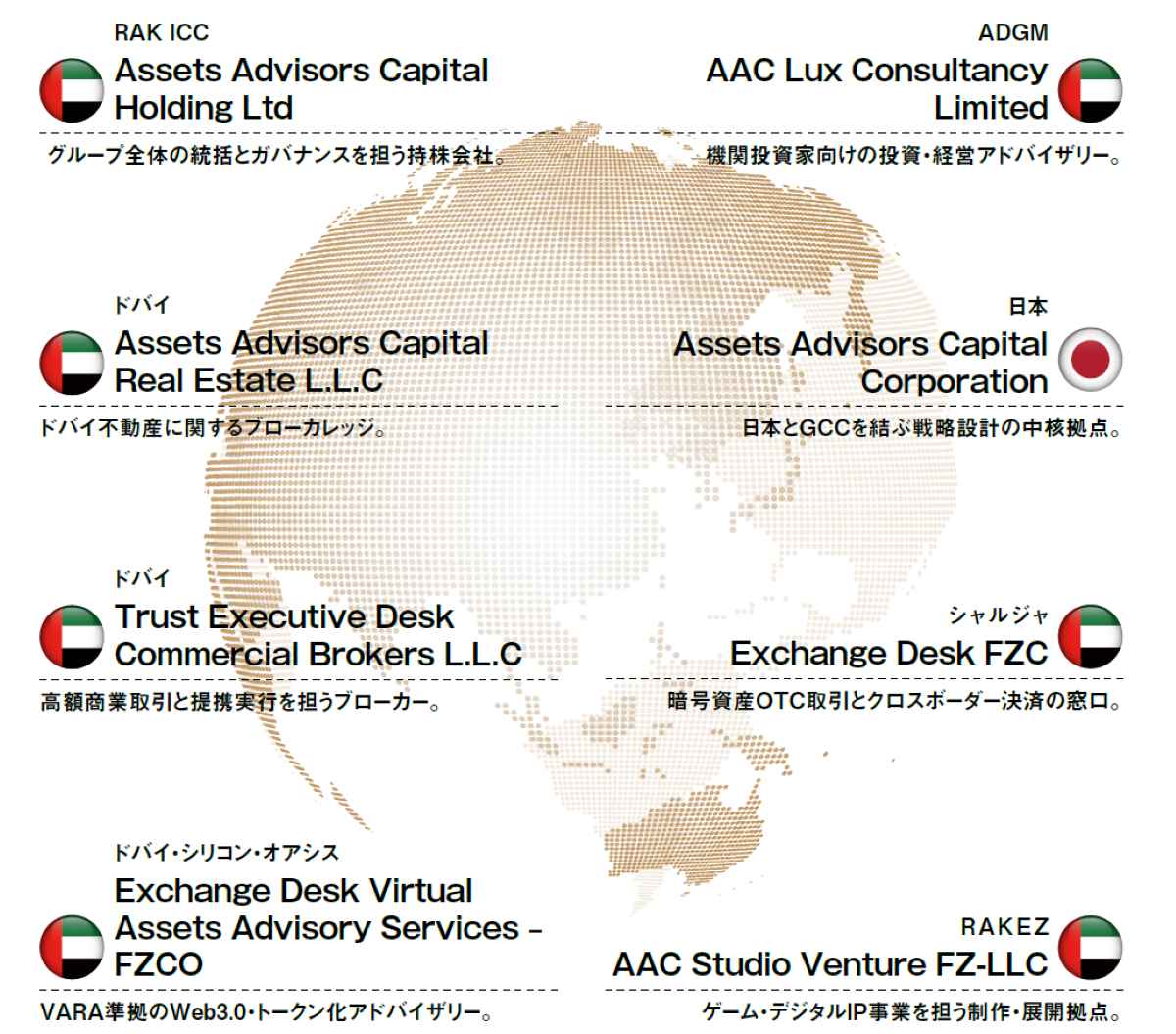
In the Middle East, it is common to separate corporations by role due to different licensing requirements and regulatory authorities for each type of business. The AAC Group uses free zones within the UAE to create a transparent, region-transcending business ecosystem.
※1 Unlike within Dubai city, special rules are prepared for foreign companies in economic zones such as ADGM (Abu Dhabi Global Market) for finance, investment, and funds, RAKEZ (Ras Al Khaimah Economic Zone) for startups and holding companies, and RAK ICC for international holding companies and asset management.
Another distinctive feature of AAC lies in its design philosophy. It views digital assets, including RWA tokens, not as short-term speculative targets, but as a foundation accessible to institutional investors in a regulatory-compliant manner.
For instance, its patented RWA module platform 'MIRAI-X' adopts an independent stance that does not directly involve itself in the custody or trading of assets, thereby eliminating conflicts of interest and custody risks through its design.
AAC emphasizes a regulatory-compliant and transparent ecosystem design, and addressing technical challenges and legal capabilities are key elements that enhance its reliability.
The ultimate vision of AAC is to become an 'investment and innovation bridge' connecting Japan and the GCC countries.
It sees the compatibility between Japan's high-quality technology, IP, and corporate culture, and the GCC's capital strength, market liquidity, and regulatory flexibility as exceptionally high, aiming to connect these at a practical level and lead to sustainable value creation.
Moreover, AAC focuses on creating a continuous cycle of value that does not end with one-off efforts.
For example, it designs RWA tokens in a regulatory-compliant manner targeting real estate, business assets, and content IP owned by Japanese companies, linking them with capital and investors from the GCC countries to present new options for fundraising and business expansion.
In the gaming and entertainment sectors, AAC also plans to adapt Japanese-origin content IP to fit the digital markets and Web3.0 context of the GCC countries, advancing commercialization through collaboration with local partners.
These initiatives not only lower the barriers for Japanese companies looking to expand overseas but also provide GCC countries with reliable access to Japanese technology and IP. AAC handles the complex regulatory designs and practical work involved in linking the two, advancing the creation of a naturally functioning environment for cross-border business collaboration.
CEO Fauzi Hamze states, 'Building a bridge that brings responsible growth and sustainable value creation between Japan and the GCC countries. That is the raison d'être of AAC, and it is a vision that will remain unchanged.'
Rather than fluctuating with short-term results, AAC, as a 'bridge between Japan and the GCC countries,' emphasizes long-term partnerships based on mutual trust and plays a crucial role in supporting the overseas expansion of Japanese companies. This effort is likely to attract more attention in the future.
When Japanese companies enter the GCC market, they face multiple barriers such as institutional design, regulatory understanding, and differences in business customs simultaneously.
AAC has established a system that supports everything from company establishment, investment design, regulatory compliance, to practical execution, thereby eliminating these barriers without fragmentation.
Instead of dispersing tasks to individual experts or external partners, AAC enables an overview of the entire process and its execution, allowing Japanese companies to step into international expansion realistically without excessive trial and error or risk.
AAC provides a framework that connects the real estate, business assets, and content IP owned by Japanese companies not just domestically, but with capital and investors in the GCC countries.
By leveraging RWA tokenization and Web3.0 technologies, AAC reconfigures assets and IP for international valuation and utilization, creating new options for fundraising and business expansion.
Moreover, AAC's ecosystem design is characterized by utilizing these Japanese assets and IPs not as short-term transactions but in a way that contributes to long-term business development.
AAC aims to establish a sustainable relationship between Japan and the GCC countries that goes beyond one-off projects or short-term results.
For businesses and capital to cross borders effectively, mutual understanding of systems and practices and a continuously functioning framework are essential. AAC handles the foundational design and coordination, preparing an environment where both Japanese companies and the GCC market can make decisions based on a common understanding.
Through these efforts, a practical, future-oriented partnership between Japanese companies and the GCC countries is likely to develop.
◉ Fawzi Hamze
Founder/CEO of Assets Advisors Capital
With over 15 years in the UAE business ecosystem, Fawzi has built a solid reputation in private banking and luxury real estate. At Qatar National Bank, he managed over $1 billion in assets for more than 100 high-net-worth clients and built a strong relationship with the Qatar Investment Authority.
Leveraging his experience in Dubai's luxury real estate market, he handles transactions of high-end properties. Currently based in Tokyo, he plays a pivotal role in bridging investment flows between the Gulf countries and Japan.

The Dawn of a New Financial Era: The Expansion of Tokenization of Real World Assets

